

The Role of Auditors in Ensuring Financial Transparency in UAE
Financial transparency is the foundational pillar of stakeholder trust, corporate accountability, and capital market stability across the United Arab Emirates. As the UAE solidifies its standing as a premier global business hub under Federal Decree-Law No. 32 of 2021 on Commercial Companies and strict Federal Tax Authority (FTA) corporate tax regulations, independent auditors serve as the frontline defenders of fiscal integrity. Through rigorous, objective examination of balance sheets, internal accounting mechanisms, and operational records, certified external auditors bridge the information gap between executive management, shareholders, lending institutions, and regulatory authorities.
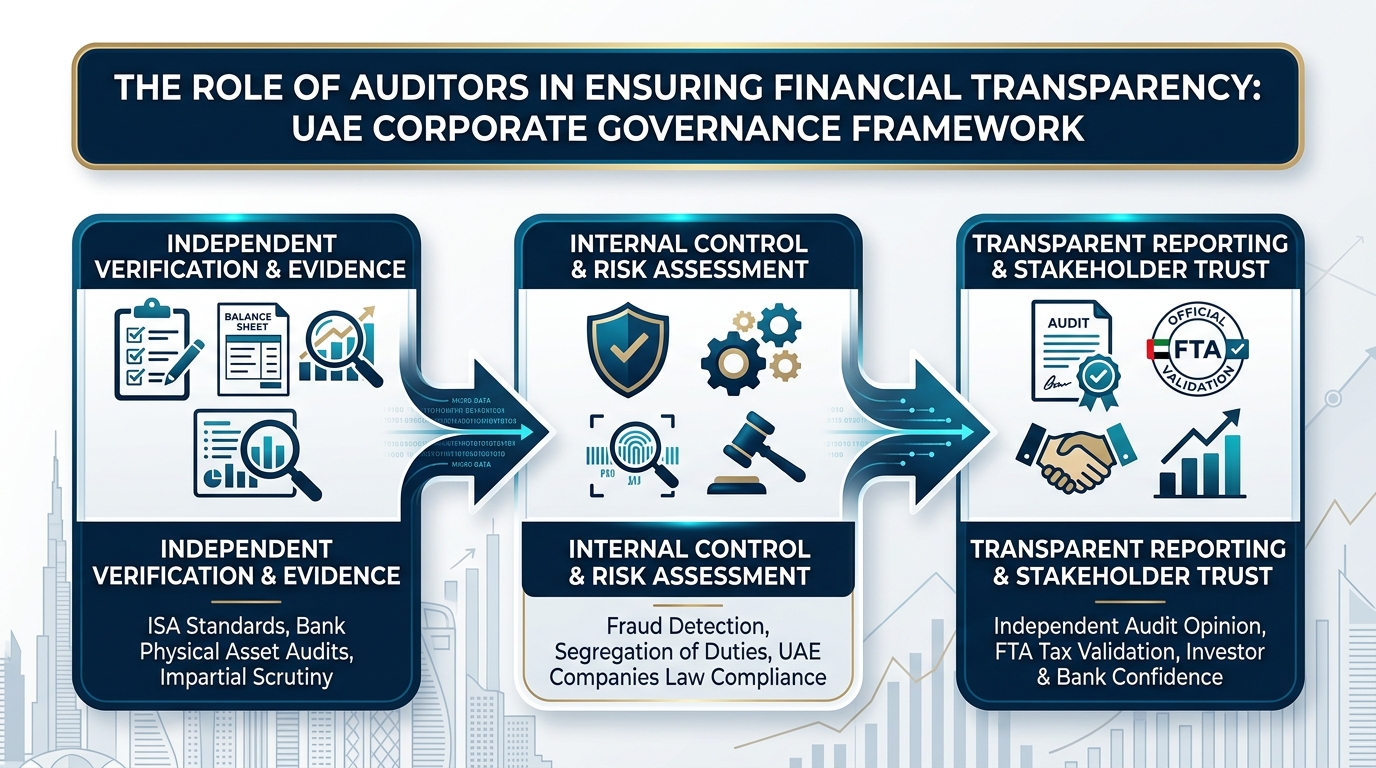
- ✓ Objective Independent Verification: External auditors evaluate corporate accounts without management bias, adhering strictly to International Standards on Auditing (ISA) and IFRS frameworks.
- ✓ Internal Controls & Fraud Prevention: Detailed examination of segregation of duties, transaction authorizations, and financial workflows protects corporate assets from material misappropriation.
- ✓ Mandatory Statutory Compliance: Satisfies statutory annual filing mandates under UAE Commercial Companies Law, free zone regulations (DIFC, DMCC, ADGM), and FTA Corporate Tax thresholds.
- ✓ Public Trust & Capital Access: Unqualified audit reports provide local and international commercial banks, private equity investors, and credit rating agencies with verifiable fiscal confidence.
- 01 The Core Imperative of Financial Transparency
- 02 Independent Verification & Impartiality
- 03 Compliance with ISA, IFRS & UAE Regulations
- 04 Detection of Errors, Irregularities & Fraud
- 05 Rigorous Assessment of Internal Controls
- 06 Enhanced Governance & Executive Accountability
- 07 Audit Opinions & Stakeholder Communication
- 08 Cultivating Public, Bank & Investor Trust
- 09 Auditor vs. Management Responsibility Matrix
- 10 Continuous Professional Development in Auditing
- 11 Frequently Asked Questions (FAQs)
1. The Core Imperative of Financial Transparency
Financial transparency is crucial for the trust and confidence of stakeholders in an organization’s financial information. Whether dealing with privately held LLCs in mainland Dubai, multinational entities in financial free zones, or family-owned enterprises, stakeholders require unambiguous, verifiable disclosures regarding a firm’s solvency, liquidity, and operational performance.
Auditors play a vital role in ensuring financial transparency by independently examining and verifying the accuracy, completeness, and fairness of financial statements. Without professional third-party assurance, financial statements remain vulnerable to management bias, aggressive revenue recognition, unrecorded liabilities, or accidental bookkeeping inaccuracies. By subjecting fiscal ledgers to systematic scrutiny, certified auditors transform raw internal data into credible financial intelligence.
2. Independent Verification & Impartiality
One of the key responsibilities of auditors is to deliver impartial verification of an organization’s financial statements. Auditors, as external professionals, maintain no affiliation with the audited organization. Their independence ensures that they can objectively assess and evaluate the financial information without any bias or conflict of interest. This independent verification instills confidence in the reliability and accuracy of the financial statements.
Under International Standard on Auditing (ISA) 200, an external auditor must maintain an attitude of professional skepticism throughout the planning and performance of the audit, recognizing that circumstances may exist that cause the financial statements to be materially misstated. In the UAE, auditors registered with the Ministry of Economy are legally required to uphold strict ethical codes, preventing conflicts of interest that could compromise their independence.
Key Pillars of Auditor Independence:
• Financial Disinterest: Auditors and their audit teams cannot hold equity, directorships, or material financial interests in the client entity.
• Segregation of Advisory Services: Auditors who execute statutory audits cannot simultaneously prepare the source accounting ledgers or calculate the final tax provisions they are assigned to review.
• Direct Reporting to Shareholders: External auditors present their independent auditor’s report directly to the shareholders and the Board of Directors at the Annual General Meeting (AGM), bypassing executive management filters.
3. Compliance with Accounting Standards and Regulations
Auditors ensure that financial statements comply with applicable accounting standards and regulations. They review the organization’s accounting policies and practices to ensure consistency and adherence to the established guidelines. By verifying compliance, auditors promote transparency and comparability of financial information across different entities and industries.
In the UAE, statutory mandates strictly enforce the adoption of International Financial Reporting Standards (IFRS) and IFRS for SMEs. Auditors evaluate critical accounting estimates, including:
- Revenue Recognition (IFRS 15): Ensuring that performance obligations are fulfilled before revenue is recognized, preventing premature revenue booking.
- Lease Accounting (IFRS 16): Verifying right-of-use assets and corresponding lease liabilities for corporate tenancies and equipment.
- Financial Instruments & Expected Credit Losses (IFRS 9): Reviewing provisions for bad debts and commercial receivables aging.
- Corporate Tax Alignment: Reconciling statutory accounting net income with taxable income according to UAE Federal Decree-Law No. 47 of 2022.
4. Identification of Errors and Irregularities
Auditors meticulously examine the financial records and transactions of an organization to identify errors, irregularities, or fraudulent activities. They scrutinize the accuracy of financial data, assess internal controls, and conduct thorough testing procedures. Through these efforts, auditors help detect and prevent financial misstatements, ensuring the transparency and integrity of the financial reporting process.
Auditing procedures designed to uncover irregularities encompass:
- Substantive Transaction Testing: Tracing sample general ledger entries back to third-party supplier contracts, delivery notes, and tax invoices.
- Direct Bank Confirmations: Independently securing bank balance and loan facility certificates directly from financial institutions to prevent falsified cash sheets.
- Inventory & Fixed Asset Physical Observation: Conducting year-end physical counts at warehouses, manufacturing plants, and retail locations to verify asset existence and condition.
- Cut-Off Testing: Ensuring transactions recorded close to the financial year-end date are allocated to the correct fiscal period.
⚠️ The Difference Between Errors vs. Fraud in Auditing
While errors refer to unintentional mathematical mistakes, oversights, or misinterpretation of facts in accounting records, fraud involves intentional deceptions designed to misrepresent financial health or misappropriate company funds. Auditors assess the risk of management override and design forensic-grade audit procedures to protect corporate integrity.
5. Assessment of Internal Controls
As part of their role, auditors assess the effectiveness of internal controls within an organization. Internal controls are systems and procedures designed to safeguard assets, prevent fraud, and ensure the accuracy of financial information. By evaluating the strength and reliability of internal controls, auditors contribute to the transparency and reliability of the financial reporting process.
During the interim audit phase, auditors perform walkthrough tests on key organizational cycles:
- Procure-to-Pay (P2P): Verification of purchase order generation, three-way matching (PO, delivery note, supplier invoice), and payment approvals.
- Order-to-Cash (O2C): Evaluation of customer credit limits, billing accuracy, collection monitoring, and reconciliation of trade receivables.
- Payroll & Wages Protection System (WPS): Verifying employee master files, timesheets, bonus authorizations, and Ministry of Human Resources and Emiratisation (MOHRE) WPS compliance.
- Information Technology General Controls (ITGC): Assessing user access rights, segregation of administrative duties in ERP systems, and cloud data backup protocols.
6. Enhanced Accountability and Governance
Auditors hold organizations accountable for their financial practices and reporting. They provide an objective assessment of the organization’s financial health, highlighting areas of strength and areas that require improvement. This accountability fosters good governance practices and encourages organizations to maintain transparency in their financial dealings.
Beyond the public audit opinion, external auditors issue a formal Management Letter (Letter of Weakness) to executive leadership and the Audit Committee. This confidential document details:
- Identified control deficiencies and operational bottlenecks discovered during audit fieldwork.
- Potential vulnerabilities to fraud, data leakage, or regulatory non-compliance.
- Practical, actionable recommendations from senior chartered accountants to remediate internal control gaps before the subsequent fiscal cycle.
7. Communication, Reporting & The 4 Audit Opinions
Auditors communicate their findings and opinions through audit reports. These reports provide a clear and concise summary of the auditor’s assessment of the financial statements. They include the auditor’s opinion on the fairness and reliability of the financial information, highlighting any material misstatements or deficiencies in internal controls. The communication of audit results to stakeholders promotes transparency and enables informed decision-making.
| Audit Opinion Type | Regulatory & Factual Basis | Impact on Stakeholder Transparency |
|---|---|---|
| Unqualified Opinion (Clean Report) | Financial statements give a true and fair view in accordance with IFRS; no material misstatements found. | Highest level of transparency. Full confidence for UAE banks, FTA tax audits, and international investors. |
| Qualified Opinion (“Except For”) | Specific, isolated material misstatement or scope limitation exists, but it is not pervasive to the whole accounts. | Transparently isolates areas of uncertainty (e.g., unverifiable foreign inventory) while validating the remaining balances. |
| Adverse Opinion | Misstatements are both material AND pervasive; financial statements are fundamentally misleading. | Critical warning flag. Alerts lenders and regulators that the corporate accounts do not reflect true economic reality. |
| Disclaimer of Opinion | Auditor was unable to obtain sufficient appropriate audit evidence due to severe limitations or lack of records. | Highlights complete opacity. Frequently triggers corporate license suspension or mandatory restructuring by free zone authorities. |
8. Public Trust, Commercial Banks & Investor Confidence
The role of auditors in ensuring financial transparency contributes to public trust and confidence in financial systems and institutions. Stakeholders, including investors, shareholders, lenders, and regulatory authorities, rely on audited financial statements to make informed decisions. The independent scrutiny and verification provided by auditors instill confidence in the accuracy and reliability of the financial information presented.
In the UAE’s competitive financing and commercial climate, audited financial statements are mandatory for:
- Commercial Bank Facilities: Securing working capital loans, trade finance, letters of credit (LC), and project financing from top UAE institutions (Emirates NBD, FAB, ADCB, Mashreq).
- Free Zone License Renewals: Satisfying mandatory annual audit submission guidelines in free zones like DIFC, DMCC, JAFZA, and RAKEZ.
- Mergers & Acquisitions (M&A): Establishing reliable baseline valuations and historical earnings (EBITDA) during due diligence.
- UAE Corporate Tax Filing: Maintaining statutory financial compliance for businesses generating revenue exceeding AED 50,000,000 and Qualifying Free Zone Persons (QFZP) claiming 0% preferential tax rates.
9. Auditor vs. Management Responsibility Matrix
A frequent misconception in corporate governance is the distinction between who prepares the accounts and who audits them. The International Standards on Auditing clearly delineate these complementary yet distinct corporate duties:
| Governance Dimension | Management Responsibilities | Independent Auditor Responsibilities |
|---|---|---|
| Preparation of Accounts | Drafting full financial statements, selecting accounting policies, and computing estimates under IFRS. | Auditing the prepared statements; expressing an objective, independent professional opinion. |
| Internal Controls | Designing, implementing, and maintaining internal controls to prevent and detect fraud or error. | Evaluating and testing the operating effectiveness of relevant internal controls. |
| Prevention of Fraud | Primary responsibility rests with management and Those Charged with Governance (TCWG). | Assessing fraud risks and obtaining reasonable assurance that accounts are free of material fraud. |
| Record Maintenance | Maintaining books of accounts for minimum 5 years (Federal Decree-Law No. 28 of 2022). | Retaining audit working papers and evidence documentation for mandatory statutory periods. |
10. Continuous Professional Development in Auditing
Auditors engage in continuous professional development (CPD) to stay updated with the evolving accounting standards, regulations, and auditing practices. They undergo regular training and professional certifications to enhance their knowledge and skills. This commitment to professional development ensures that auditors are equipped to effectively address emerging challenges and complexities in the financial reporting environment.
At Nadeem and Umendra Chartered Accountants (NUFCA), our audit teams participate in ongoing continuous education covering emerging UAE tax decrees, anti-money laundering (AML/CFT) frameworks, automated AI-driven audit analytics, and IFRS updates. This relentless dedication ensures that every audit opinion delivered provides rigorous assurance recognized by banks, courts, and regulators across the United Arab Emirates.
💡 Summary Conclusion
Auditors fulfill a crucial role in upholding financial transparency through their independent verification of financial statements, ensuring adherence to accounting standards, identifying errors and irregularities, evaluating internal controls, fostering accountability and governance, communicating audit findings, and cultivating public trust and confidence. Their objective and independent assessment of financial information significantly contributes to the transparency, reliability, and integrity of the financial reporting process. By providing an unbiased evaluation, auditors strengthen the credibility of financial information and contribute to a more robust financial ecosystem.
Frequently Asked Questions (FAQs)
Q1 Is financial statement audit mandatory for all companies in the UAE?
Q2 How does an external audit differ from an internal audit?
Q3 Can an external auditor guarantee that a company is 100% free of fraud?
Q4 What qualifications must an auditor possess to practice in the UAE?
Q5 How does financial transparency benefit a UAE business seeking bank financing?
Q6 What is a Management Letter, and how does it promote internal transparency?
Q7 How does the UAE Corporate Tax regime impact the need for audit transparency?
Q8 How long are companies in the UAE legally required to maintain financial and audit records?
Q9 What happens if an auditor issues a “Disclaimer of Opinion”?
Q10 Can the same firm perform bookkeeping and statutory audit for a client?
Explore Related Audit & Assurance Services
Related Practical Guides
Need Independent Statutory Audit or Assurance in the UAE?
Nadeem and Umendra Chartered Accountants (NUFCA) is a Ministry of Economy registered audit firm delivering impartial, IFRS-compliant assurance for mainland enterprises and free zone corporations across Dubai, Abu Dhabi, and the Northern Emirates.