

Outsourced Accounting Services in the UAE: A Straight-Talking Guide for Business Owners

Ask any founder in the UAE what keeps them up at night, and “reconciling last month’s bank statement” probably won’t make the list. Yet the numbers side of the business quietly shapes everything else: whether your VAT returns hold up, whether you’re ready for corporate tax, whether the bank says yes to that credit line, and whether you actually know if you’re making money.
That’s why more companies here are handing their accounting to an outside team instead of building a finance department from scratch. This guide explains what that really looks like, who it suits, what it costs, and how to pick a partner who’ll make your life easier rather than harder.
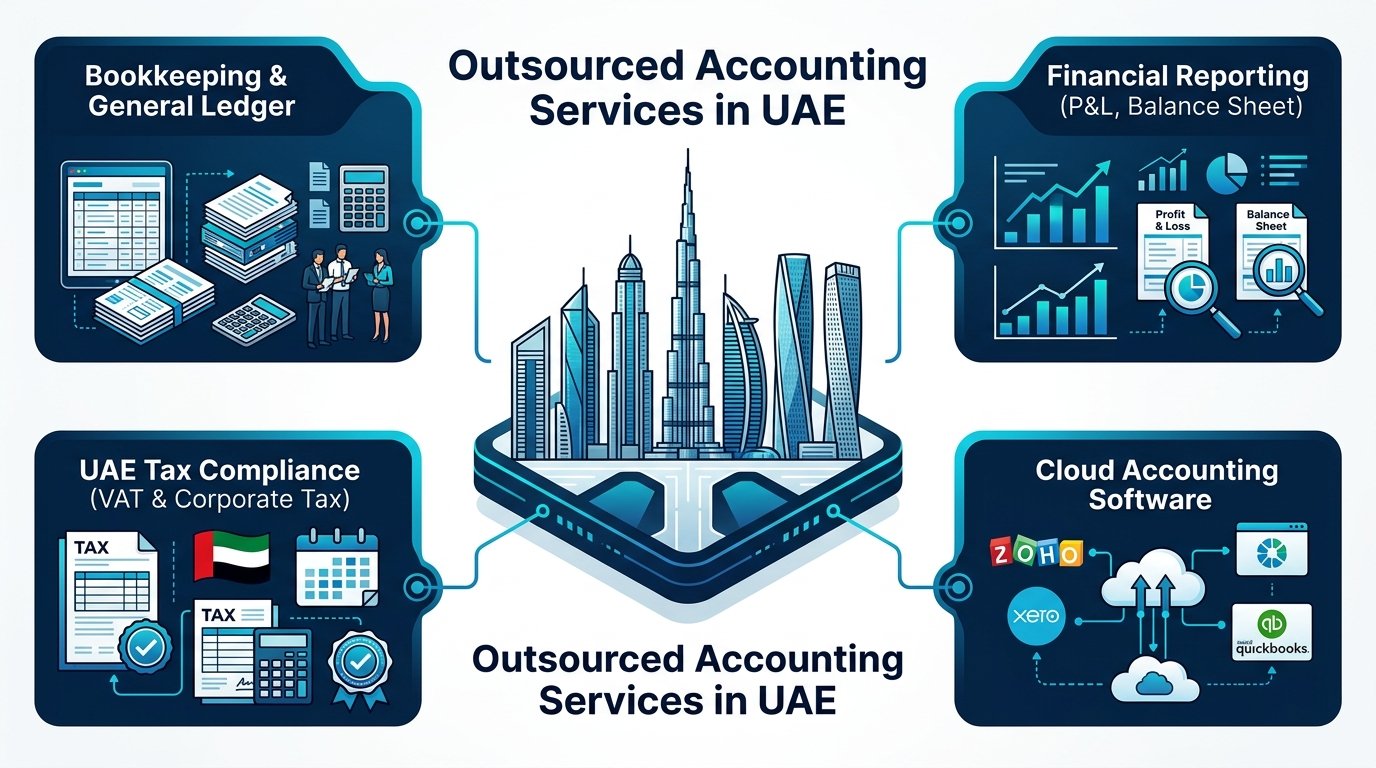
Executive Summary / TL;DR
- Cost Efficiency: Swaps full-time payroll, residency visas, health insurance, and gratuity liabilities for a predictable, transparent monthly fee.
- Team-Based Oversight: Provides daily bookkeeping backed by senior accountant reviews and specialist tax advisory, eliminating key-person dependency.
- Statutory Readiness: Keeps ledgers audit-grade and continuously reconciled for UAE Corporate Tax calculations, VAT returns, and banking reviews.
- Cloud Transparency: Full real-time access to cloud accounting platforms like Zoho Books, Xero, and QuickBooks so management retains complete visibility.
02Why UAE Businesses Outsource
03Core Service Offerings Matrix
04Is It Right for Your Business?
05Outsourcing vs In-House Accountant
06Practical 5-Step Engagement Routine
07Cloud Software & Tax Integration
08Pricing Factors & Choosing a Partner
09Frequently Asked Questions
What Does “Outsourced Accounting” Actually Mean?
It’s pretty simple. Instead of hiring accountants onto your payroll, you bring in an external firm to look after your books. They do the work either remotely or with someone assigned specifically to your account, and you get the results without the hiring, training and visa paperwork.
Depending on what you need, they can take care of:
- Recording your day-to-day transactions
- Matching your bank statements to your books
- Tracking what you owe suppliers and what customers owe you
- Payroll entries
- Monthly and yearly financial reports
- Keeping your records ready for VAT and corporate tax
- Getting everything organised before your audit
- Setting up and running your accounting software
The idea is that the finance side runs quietly in the background while you get on with running the business.
Why So Many UAE Businesses Go This Route
It’s Usually Cheaper Than You’d Think
A full-time accountant isn’t just a salary. There’s the visa, medical insurance, end-of-service gratuity, software licences, a desk, a laptop, and the time you spend managing them. Then there’s the risk: if that one person leaves, your books walk out the door with them.
An outsourcing arrangement swaps all of that for a predictable monthly fee.
You Get a Team, Not Just One Person
When you hire one accountant, you get one person’s experience. When you outsource, you typically get someone doing the daily work, someone more senior reviewing it, and specialists on hand when a tax or reporting question comes up. That’s a lot of expertise for a business that might not need a full-time accountant at all.
Fewer Mistakes, Cleaner Books
A structured team with review steps catches errors before they snowball. Bank balances match, invoices are filed where they should be, and your financial statements actually make sense. Come audit time, that difference is very noticeable.
Staying on the Right Side of the Rules
UAE businesses now juggle VAT, corporate tax, and in many cases audit obligations too. All of these depend on proper records. A good outsourced team keeps your books in a state where you can answer any question from the tax authority or your auditor without scrambling.
What’s Typically on the Menu
Most firms let you pick and choose, so you only pay for what you actually use. The typical service scope covers:
| Service | What It Covers |
|---|---|
| Bookkeeping | Recording every sale, purchase and expense properly |
| Bank Reconciliation | Making sure your books match what’s actually in the bank |
| Payables | Keeping on top of supplier bills and due dates |
| Receivables | Tracking customer invoices and chasing what’s overdue |
| Payroll Accounting | Recording salaries and related costs correctly |
| Financial Reports | Profit and loss, balance sheet and cash flow statements |
| VAT Support | Organising records and reconciling them for your returns |
| Corporate Tax Support | Keeping your figures ready for tax calculations and filings |
| Audit Readiness | Pulling together what your auditor needs, before they ask |
Is It Right for Your Business?
Different corporate profiles benefit from outsourced accounting in distinct ways:
🚀 Startups
You need your books done properly from day one, but a full-time finance hire rarely makes sense in year one. Outsourcing fills the gap without eating your runway.
🏢 Small and Mid-Sized Companies
This is where outsourcing really shines. You get monthly reports, proper processes and a clearer view of your cash, without the cost of a finance department.
🌐 Free Zone Companies
Many free zones expect proper accounting records and annual financial statements. An outside team keeps you ready for renewals and audits.
📦 Trading Businesses
Stock, supplier balances, customer credit, margins on each product line: there’s a lot to keep track of. An experienced team helps you see where the money’s really going.
🌍 Overseas Companies with a UAE Presence
If your head office is abroad, a local partner who understands UAE requirements saves you a lot of guesswork.
Outsourcing vs Hiring Your Own Accountant
Choosing between an internal hire and an external firm involves weighing cost, expertise, and operational convenience:
| Dimension | Outsourced Team | In-House Accountant |
|---|---|---|
| Cost | Fixed monthly fee | Salary plus visa, insurance, gratuity and overheads |
| Know-how | Several people with different specialties | One person’s experience |
| Flexibility | Scale up or down as you grow | Growing means hiring again |
| Tax and Compliance | Specialists usually available | Depends on the individual |
| Reporting | Set routine and formats | Depends on your internal setup |
Balanced Perspective
To be fair, an in-house accountant does have advantages. They sit in your office, know your team and can respond instantly. For some larger businesses, that matters. But for many small and growing companies, outsourcing simply gives more for less.
How It Works in Practice
A professional outsourcing partnership follows a clear, predictable monthly operational rhythm:
Getting to Know Your Business
The firm looks at how you currently keep your books, what you sell, how money comes in and goes out, and what reports you need.
Setting Things Up
Your existing records are cleaned up and moved into the right system. If the books are a bit of a mess, this is where it gets sorted.
The Monthly Routine
Transactions get recorded, bank accounts reconciled, invoices processed and expenses categorised.
Review and Reports
A senior accountant checks the work, then you get reports that tell you how the business is really doing.
Tax and Audit Support
When VAT returns, corporate tax filings or your annual audit come round, your records are already in shape.
The Software Side & Where Tax Comes Into It
Cloud Accounting Software
Most outsourcing firms work with popular cloud platforms, such as Zoho Books, QuickBooks Online and Xero, as well as Tally and larger ERP systems for bigger operations.
The nice thing about cloud accounting is that you’re not left in the dark. You can log in any time, check your figures, and your accountant sees exactly the same numbers you do.
Corporate Tax
Since the UAE brought in corporate tax, keeping good books has gone from “nice to have” to essential. Your taxable profit is worked out from your accounts, so if the records are shaky, the tax figure will be too. An outsourced team keeps your transactions, statements and supporting paperwork in a state that’s ready for filing.
VAT
If you’re VAT registered, your returns have to line up with your accounting records. Your accountants can review VAT-related transactions, reconcile the figures and get everything ready so your returns go in on time and with confidence.
What Will It Cost & Picking the Right Partner
What Will It Cost?
There’s no one-price-fits-all, and you should be a little wary of anyone who quotes without asking questions. Fees usually depend on:
- How many transactions you have: More activity means more hours.
- How big you are: More entities, staff and bank accounts all add work.
- Your industry: Some sectors need more specialised handling.
- The state of your books: If there’s a backlog to clean up, expect a one-off catch-up fee.
- What reports you want: Basic monthly figures cost less than detailed management packs.
Most firms will put together a package based on your needs. Ask for a clear quote listing exactly what’s included.
Picking the Right Partner
A few things worth checking before you sign:
- Local experience: They should know UAE accounting practice, VAT and corporate tax inside out.
- The people: Ask who’ll actually be handling your account and what qualifications they hold.
- Tools and reporting: Find out what software they use and ask to see a sample of the reports you’ll receive.
- Industry fit: Someone who’s worked with businesses like yours will pick things up much faster.
- Clear pricing: Know what’s covered in the monthly fee and what gets billed on top. Surprises on an invoice from your accountant are never a good look.
Frequently Asked Questions
Q1 What exactly would an outsourced accountant do for me?
▾
They’d handle your bookkeeping, reconciliations, reports, and help keep your records ready for VAT, corporate tax and audits.
Q2 Why not just hire someone in-house?
▾
You can, and sometimes that’s the right move. But outsourcing is often cheaper, gives you access to more expertise, and doesn’t leave you stuck if one person resigns.
Q3 Is it worth it for a small business?
▾
Very often, yes. It’s one of the most common reasons startups and SMEs outsource in the first place.
Q4 Will they help with VAT?
▾
Most firms do. They’ll organise and reconcile your records so your returns are accurate.
Q5 Can they prepare my financial statements?
▾
Yes. Along with management reports tailored to what you want to see.
Q6 How much does it cost?
▾
It depends on your transactions, size, industry and reporting needs. Get a tailored quote.
Q7 Is outsourcing better than an in-house accountant?
▾
It depends on your business. Outsourcing gives you a wider team for less, while in-house gives you someone on site. Plenty of companies start with outsourcing and bring the role in-house later as they grow.
The Bottom Line
Good accounting isn’t just about keeping the tax authority happy. It’s about knowing where your business stands so you can make smart decisions. Outsourcing gives you that clarity, backed by a proper team, without the cost of building one yourself.
If you go this route, look for a partner who knows the UAE well, has qualified people, and is upfront about what they charge.
Want your books handled properly so you can focus on growing? Get in touch with our team for an accounting package built around your business.
Related Accounting & Advisory Services
Related Practical Articles & Guides
Looking to Outsource Your Accounting in the UAE?
Speak directly with our chartered accounting team. We assess your transaction volumes, reporting needs, and tax obligations to build a transparent, tailored monthly package.