
Dubai Escrow Account Audit Requirements for Cost Consultants & RERA Developers

Dubai’s real estate sector is globally celebrated for its architectural daring, transparent investor protections, and institutional-grade stability. The cornerstone of this market credibility is the Real Estate Regulatory Agency (RERA) escrow framework, established under Law No. (8) of 2007 Concerning Escrow Accounts for Real Estate Development in the Emirate of Dubai.
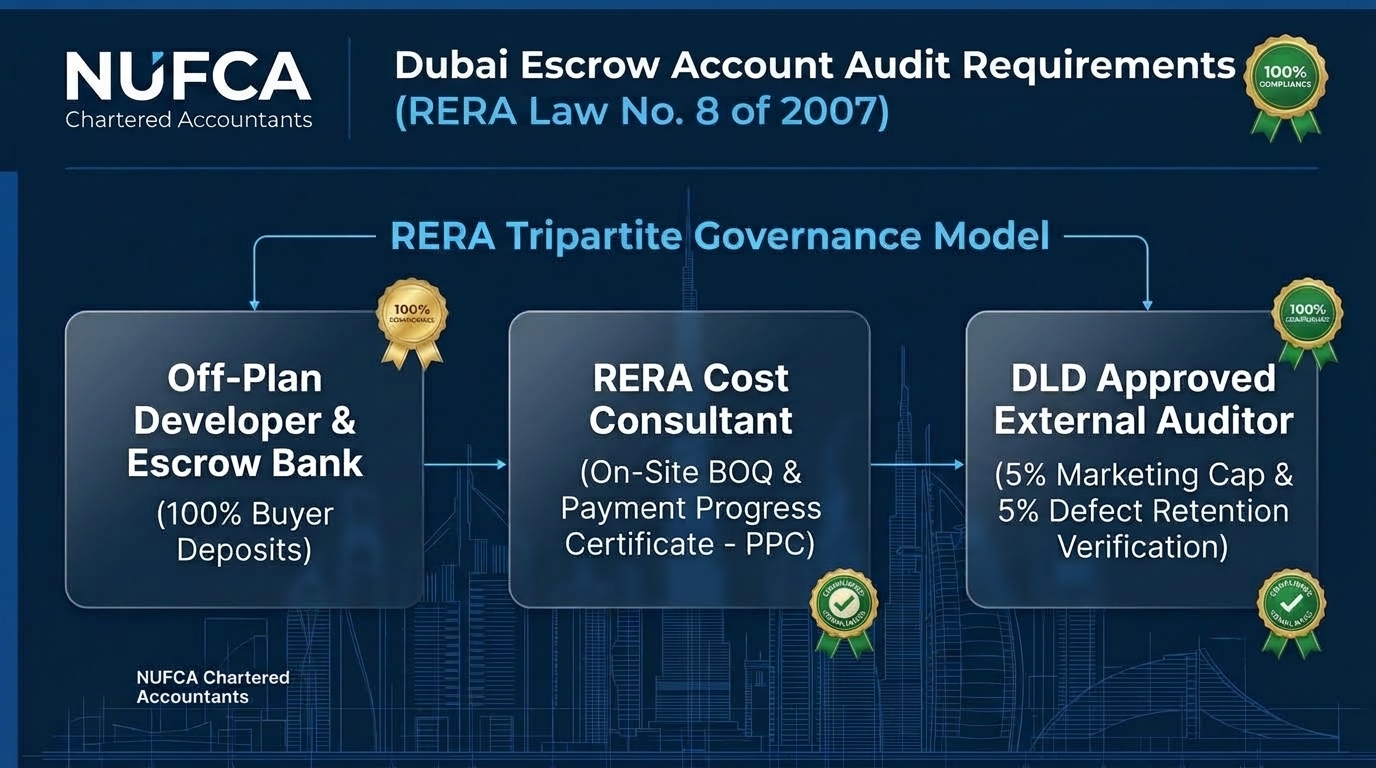
Under Law No. (8) of 2007, developers selling off-plan real estate units must deposit 100% of investor collections into a project-specific Escrow Account (Trust Account). Withdrawal of these funds is strictly contingent upon independent on-site milestone certification by a RERA-approved Cost/Engineering Consultant via official Payment Progress Certificates (PPCs), followed by statutory financial reconciliation by a RERA-approved external auditor registered with the Dubai Land Department (DLD).
For project developers, main contractors, and particularly cost consultants and quantity surveyors, this comprehensive guide details the exact Dubai escrow account audit requirements for cost consultants RERA enforces, explaining how physical construction verification links directly to statutory financial audit clearances.
Executive Summary / TL;DR
- Law No. (8) of 2007 Mandate: 100% of off-plan buyer installment payments and project financing must be deposited into a dedicated project Escrow Account with a DLD-accredited bank.
- Cost Consultant PPC Certification: Escrow banks cannot release construction stage payments without a signed Payment Progress Certificate (PPC) from a RERA-accredited Cost/Engineering Consultant verifying physical BOQ completion.
- Strict Statutory Caps: Marketing and brokerage withdrawals are capped at a maximum of 5% of total collected funds, and 5% of total funds must be retained for 1 full year post-completion for defect liability.
- DLD Tasqeel & Audit Reconciliation: Any discrepancy between the Cost Consultant’s certified completion percentage and DLD’s independent engineering inspection triggers an immediate freeze on escrow disbursements until resolved by audit.
02Audit Requirements for Cost Consultants
03Cost Consultant PPC & DLD Audit Matrix
04Permitted Disbursements & 5% Caps
05The 12-Point RERA Escrow Audit Checklist
06Why Work with NUFCA RERA Auditors
07Frequently Asked Questions (FAQs)
08Related Real Estate & Audit Guides
1. The Tripartite Governance Model: Law No. (8) of 2007
In Dubai, an off-plan property developer does not hold discretionary authority over investor monies. The legal framework establishes three mutually independent entities to safeguard project funds:
1. The Real Estate Developer (المطور العقاري)
Licensed by the DLD, the developer is responsible for opening an individual Escrow Account with an accredited commercial Escrow Agent (bank) for each approved project. All off-plan sales proceeds, buyer installment payments (Oqood-linked), and project financing must be deposited exclusively into this account.
2. The Independent Cost & Engineering Consultant (مستشار التكلفة والاستشاري الهندسي)
An autonomous engineering and cost consultancy practice accredited by RERA. The consultant supervises on-site construction, verifies contractor billing against the Bill of Quantities (BOQ), and certifies the actual physical stage of completion through formal Payment Progress Certificates (PPCs).
3. The RERA-Approved External Auditor (مدقق معتمد من ريرا)
An independent chartered auditing firm—such as NUFCA—registered on the Dubai Land Department’s approved auditor panel. The auditor independently inspects financial records, reconciles buyer ledgers against bank statements, cross-checks Cost Consultant PPCs, confirms compliance with disbursement caps, and issues the official annual Escrow Account Audit Report.
2. Dubai Escrow Account Audit Requirements for Cost Consultants & Engineers
For cost consultants and quantity surveying firms operating on Dubai off-plan projects, RERA mandates strict technical protocols before escrow funds can be disbursed to contractors or developers:
A. On-Site Physical Inspection & Milestone Verification
Disbursements cannot occur on theoretical or chronological schedules. The cost consultant must conduct rigorous physical on-site audits to verify that executed construction matches approved architectural blueprints, structural engineering specifications, and the Bill of Quantities (BOQ).
B. Issuance of Payment Progress Certificates (PPCs)
The cost consultant is legally responsible for preparing and signing the Payment Progress Certificate. This document specifies:
- Cumulative percentage of actual physical project completion.
- Gross value of construction work completed by the main contractor to date.
- Deduction of previously certified disbursements.
- Retention monies withheld (typically 10% on monthly interim bills).
- Approved net amount recommended for withdrawal from the Escrow Account.
C. Validation of Variation Orders (VOs) & Contingency Budgets
Any scope adjustments, variations, or claims exceeding the original contract sum must be formally scrutinized by the cost consultant. RERA’s escrow audit department examines whether variation orders were accompanied by formal client approval and verified funding sources before recognizing increased project costs.
D. Synchronization with DLD Project Progress Inspection Reports
RERA conducts its own periodic physical engineering inspections through DLD technical officers (recorded via the DLD Tasqeel / Land Regulatory system). If a discrepancy arises between the cost consultant’s certified completion percentage (e.g., claiming 65%) and RERA’s independent inspection report (e.g., assessing 52%), the Escrow Agent is instructed to freeze further fund releases until an exhaustive technical and financial audit resolves the variance.
3. Cost Consultant Audit Dossier & RERA Verification Matrix
When RERA-approved external auditors examine project withdrawals, they cross-examine the cost consultant’s technical deliverables against bank disbursements using the following statutory verification matrix:
| Cost Consultant Deliverable | RERA Technical Requirement | External Auditor Reconciliation Check |
|---|---|---|
| Baseline Bill of Quantities (BOQ) & Cash-Flow Schedule | Must align with DLD-approved master construction budget and FIDIC contract sum prior to escrow opening. | Reconciles baseline construction cost budget against total escrow cash-inflow projections and developer equity guarantees. |
| Interim Payment Certificates (IPCs) & PPCs | Signed and stamped by RERA-registered project engineer and cost consultant confirming physical stage completion. | Traces every bank wire transfer out of the escrow account directly to a numbered, signed PPC and contractor tax invoice. |
| Contractor Retention Ledger (10% Interim Holdback) | Standard 10% deduction from interim contractor progress bills (up to 5% of total contract value). | Verifies that retention liabilities are accurately recorded and not prematurely disbursed prior to Taking-Over Certificate (TOC). |
| Variation Order (VO) Assessment Log | Independent quantity surveyor valuation of structural/MEP scope changes and material price adjustments. | Tests whether VOs breached the project contingency reserve or required supplemental developer capital injection. |
| Cost-to-Complete (CTC) Sufficiency Report | Periodic engineering calculation of remaining cost required to reach 100% Building Completion Certificate (BCC). | Compares remaining escrow cash balance + uncollected Oqood receivables against Cost Consultant’s certified CTC. |
4. Permitted Escrow Account Disbursements & Regulatory Caps
Law No. (8) of 2007 and DLD regulations explicitly restrict what developer expenditures can be funded using escrow money. During an annual escrow audit, auditors scrutinize all transactions against these statutory thresholds:
| Expense Category | RERA Regulatory Condition & Cap | Audit Documentation Required |
|---|---|---|
| Main Contractor Payments | Released strictly in stages based on certified on-site progress. | Signed Payment Progress Certificate (PPC) from Cost Consultant + Contractor Tax Invoice. |
| Engineering & Cost Consultancy Fees | Permitted in alignment with the consultancy agreement milestone schedule. | Consultancy Contract + Interim Fee Invoices + Evidence of active RERA professional registration. |
| Marketing & Advertising Expenses | Capped at maximum 5% of the total funds deposited into the escrow account. | Media invoices, agency contracts, and marketing expenditure ledgers. |
| Project Management Fees | Allowed only within RERA-stipulated percentage thresholds. | Project Management Agreement + Board approvals. |
| Land Value Repayment | Conditional: Land payments are permitted only if pre-approved by RERA and if the project construction has reached required completion benchmarks (often ≥20%). | Title deed clearance, DLD NOC, and formal RERA Trust Account approval letter. |
| Defect Liability / Retention Reserve | Mandatory 5% retention of total collections withheld for 1 full year post-completion. | Escrow Agent confirmation of segregated maintenance account balance. |
⚠️ Article 16 Penalties: Severe Legal Repercussions for Misrepresentation
Under Article 16 of Law No. (8) of 2007, any real estate developer, cost consultant, engineer, or auditor who provides false information, issues fraudulent progress certificates, or knowingly conceals material facts regarding an escrow account faces imprisonment and administrative fines up to AED 100,000 or more, alongside permanent disqualification from practicing real estate activities in Dubai.
5. The 12-Point Comprehensive RERA Escrow Audit Verification Checklist
When NUFCA conducts a statutory Escrow Account Audit for submission to the Dubai Land Department, our audit team executes a rigorous, multi-tiered 12-point inspection program:
Escrow Agreement & Bank Reconciliation
Verifying tripartite agreement between Developer, Escrow Bank, and DLD. 100% line-by-line reconciliation of all bank transactions against project accounts.
Off-Plan Sales Register Inspection
Reconciling buyer sales contracts (Oqood registrations) with credited bank deposits to guarantee zero diversion to private corporate accounts.
Mortgage & Bank Facility Verification
Reviewing project construction financing drawdowns, debt-servicing schedules, and tracking loan repayments funded through escrow.
Cost Consultant Certificate Cross-Check
Comparing all Payment Progress Certificates (PPCs) issued by engineering consultants directly against DLD on-site physical inspection certificates.
Contractor & Subcontractor Payment Tracing
Confirming disbursements reached genuine project suppliers, verifying proof of bank transfers, and checking contractor receipt acknowledgments.
Marketing Fee Audit (5% Statutory Cap)
Testing total cumulative marketing and advertising withdrawals to confirm they strictly remain within the 5% statutory ceiling on collected funds.
Land Cost Allocation Check
Ensuring land cost disbursements complied with DLD mortgage clearances and the prerequisite 20% construction milestone.
Contingency & Variation Order Validation
Auditing engineering variations (VOs) for formal client approvals, technical justifications, and pricing accuracy.
5% Defect Liability Maintenance Reserve
Confirming the escrow agent retains 5% of all funds collected for 12 months after Building Completion Certificate (BCC) issuance.
Value Added Tax (VAT) Compliance
Confirming proper accounting of 5% Output VAT on commercial sales and verifying that contractors issued valid FTA tax invoices with 15-digit TRNs.
Corporate Tax Deductibility Mapping
Aligning project expenses with general ledger codes for 9% Corporate Tax compliance under Federal Decree-Law No. 47 of 2022.
Final Escrow Audit Dossier & DLD Upload
Compiling official standardized RERA Escrow Audit Dossier for electronic upload through the DLD Land Regulatory Portal.
6. Why Work with NUFCA for RERA Escrow Audits in Dubai?
Conducting real estate escrow audits requires specialized technical familiarity with FIDIC construction contracts, quantity surveying methodologies, and direct regulatory relationships with RERA’s Trust Account Department.
DLD & RERA Approved Auditors
Officially accredited by the Dubai Land Department to audit project trust accounts and owners associations across Dubai.
Engineering & Audit Synergy
Our audit managers work directly with cost consultants, PMOs, and contractors to reconcile construction schedules with bank registers.
Full Real Estate Compliance Suite
Comprehensive statutory support across RERA Escrow Audits, Mollak Audits, and Internal Audits.
Rapid Clearances & Zero Defects
Eliminating DLD regulatory query delays with meticulously compiled working paper files that facilitate immediate milestone fund releases.
7. Frequently Asked Questions (FAQ)
Click any question below to expand the full answer regarding RERA escrow audit requirements for cost consultants and developers.
Q1What are the Dubai escrow account audit requirements for cost consultants under RERA?
+
Cost consultants and engineering firms accredited by RERA must conduct physical on-site inspections, verify actual completed construction against the approved Bill of Quantities (BOQ), and issue a formal Payment Progress Certificate (PPC). Escrow funds cannot be released by the Escrow Agent (bank) without this certification, and all cost consultant PPCs are subject to independent reconciliation by RERA-approved external auditors and DLD engineering inspectors.
Q2Which legislation governs real estate escrow accounts in Dubai?
+
Real estate escrow accounts in Dubai are governed by Law No. (8) of 2007 Concerning Escrow Accounts for Real Estate Development in the Emirate of Dubai, overseen by the Real Estate Regulatory Agency (RERA) and the Dubai Land Department (DLD).
Q3What documents must a cost consultant submit for a RERA escrow account audit?
+
Cost consultants must provide signed Payment Progress Certificates (PPCs), approved Bill of Quantities (BOQ) schedules, Interim Payment Certificates (IPCs), evaluated Variation Orders (VOs) with developer approvals, contractor retention ledgers (typically 10% interim retention), and reconciliation logs matching DLD Tasqeel technical inspection percentages.
Q4How much can a developer withdraw from the escrow account for marketing expenses?
+
Under RERA regulations, marketing, brokerage, and advertising withdrawals from an off-plan project escrow account are strictly capped at a maximum of 5% of the total funds deposited into the account. Auditors verify that cumulative marketing expenses remain strictly within this 5% statutory ceiling.
Q5What is the 5% retention requirement on Dubai escrow accounts?
+
Under Law No. (8) of 2007, RERA requires that 5% of the total funds received in the escrow account be retained for a period of one full year following the issuance of the Building Completion Certificate (BCC) and registration of units in buyers’ names. This retention fund protects buyers by covering structural or latent defects during the initial defect liability period.
Q6What happens if the cost consultant’s report conflicts with the DLD inspection report?
+
If the cost consultant certifies a completion percentage higher than what DLD technical inspectors verify on-site, RERA immediately instructs the Escrow Agent bank to freeze further escrow withdrawals. An independent joint technical review and financial audit must resolve the variance before fund releases can resume.
Q7Can a developer use escrow funds from Project A to finance Project B?
+
No, absolutely not. Every off-plan real estate project in Dubai must maintain a dedicated, isolated escrow account. Diverting or co-mingling funds between different projects is illegal under Law No. (8) of 2007 and constitutes a criminal breach of trust punishable by imprisonment and heavy administrative fines under Article 16.
Q8Who can conduct an official RERA Escrow Account Audit?
+
Only professional chartered accountancy and auditing firms that are officially registered and approved by the Dubai Land Department (DLD) and RERA are authorized to audit real estate project trust accounts. NUFCA is fully accredited to conduct these statutory audits.
Q9How often must an escrow account be audited in Dubai?
+
Escrow accounts are subject to mandatory annual statutory audits, as well as periodic milestone-based compliance reviews whenever major disbursements, project restructuring, mortgage drawdowns, or final project closures are requested from RERA.
Q10How does UAE Corporate Tax and VAT apply to Dubai escrow account disbursements?
+
During an escrow audit, auditors verify that 5% Output VAT on commercial off-plan sales is properly accounted for, that main contractors and cost consultants issue valid FTA Tax Invoices with 15-digit TRNs for input VAT recovery, and that project construction costs are accurately mapped to general ledger codes for 9% UAE Corporate Tax compliance under Federal Decree-Law No. 47 of 2022.
Related Real Estate Audit & Assurance Services
Related Practical Guides & Regulatory Insights
Ensure Flawless RERA Escrow Account Audit Compliance
Partner with NUFCA’s DLD-approved real estate auditors in Dubai to guarantee accurate milestone reconciliations, compliant cost consultant certificates, and rapid DLD approvals.