

How to Calculate Liquidation Value for Your Business in the UAE

When an enterprise faces operational distress, shareholder dissolution, or formal insolvency, determining its true Liquidation Value is critical. This metric establishes the realistic net cash that can be realized from selling all tangible company assets under accelerated conditions, after fully settling all secured, unsecured, and statutory debts.
In the UAE’s commercial landscape, knowing this number serves as the baseline for evaluating exit strategies, negotiating restructuring agreements under the UAE Bankruptcy Law (Federal Decree-Law No. 51 of 2023), and preparing the mandatory Company Liquidation Audit Report required by licensing authorities.
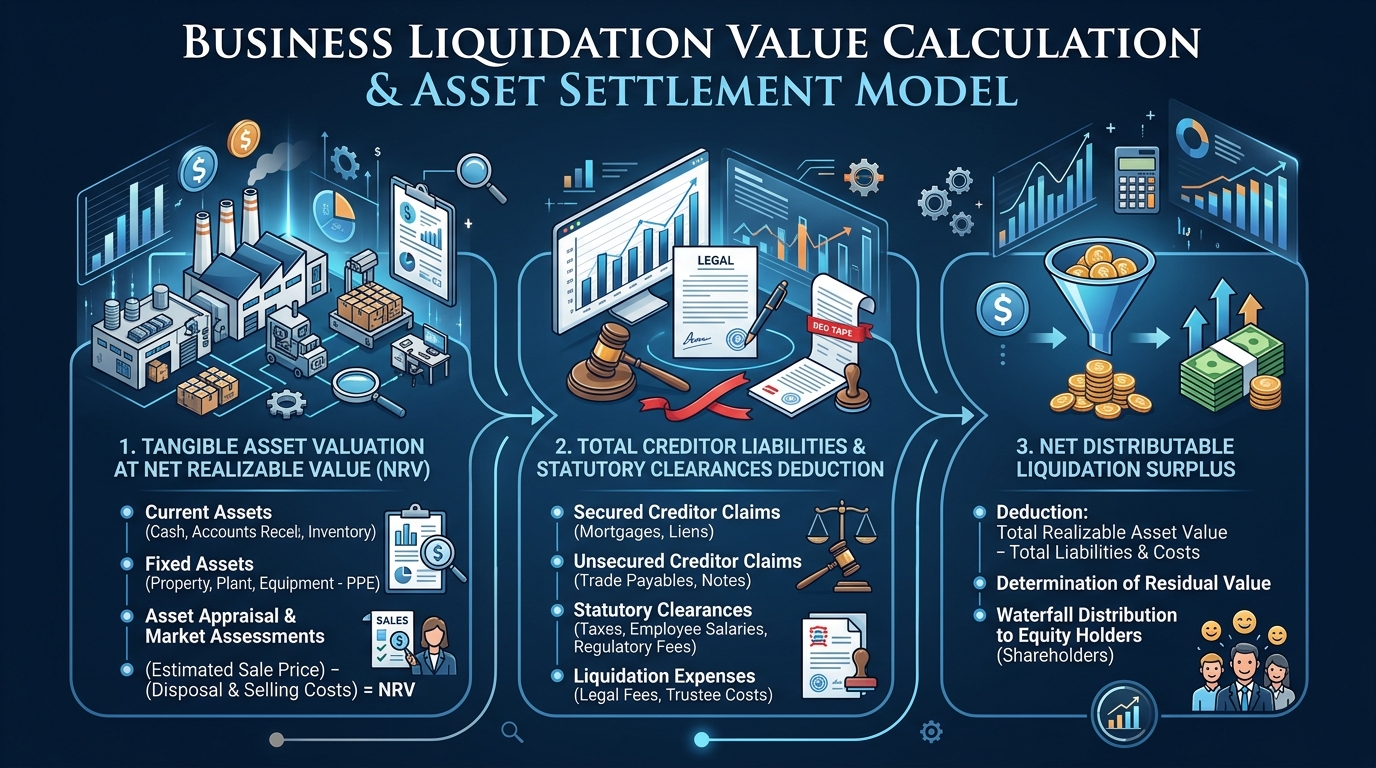
Executive Summary: Key Takeaways
- Tangible Assets Only: Liquidation value strictly appraises physical and liquid assets (machinery, real estate, vehicles, inventory, and receivables at Net Realizable Value), excluding intangibles such as brand goodwill or patents.
- Orderly vs. Forced Liquidation: Orderly Liquidation Value (OLV) assumes an adequate marketing window (3 to 6 months) recovering 60%–80% of book value, whereas Forced Liquidation Value (FLV / auction) discounts deeply to 20%–40%.
- Statutory Settlement Waterfall: Under UAE Commercial Companies Law, asset proceeds must satisfy claims strictly in order: liquidation costs, employee wages and end-of-service gratuities, secured bank debts, and unsecured trade payables.
- Independent Audit Mandate: Licensing authorities across Dubai (DED), Abu Dhabi (ADDED), and Free Zones (DMCC, JAFZA, DAFZA, RAKEZ) require a certified final liquidation audit report from an approved chartered accountant before license cancellation.
1. What Exactly is Business Liquidation Value?
Liquidation value represents the net cash consideration that would remain if an enterprise completely ceased operational activities, auctioned or sold all its physical assets on an expedited basis, and used the gross proceeds to discharge all outstanding commercial obligations.
Unlike a “Going Concern” valuation—which discounts future projected cash flows and assigns significant monetary weight to goodwill, market reputation, intellectual property, and recurring contracts—liquidation value is strictly grounded in the Net Realizable Value (NRV) of tangible physical assets.
Core Accounting Principle
Under International Financial Reporting Standards (IFRS) and UAE corporate governance standards, once a company’s shareholders pass a resolution to wind down, the “Going Concern” accounting basis ceases to apply. Financial statements must immediately pivot to the Liquidation Basis of Accounting, valuing assets at estimated net realizable selling prices and recognizing all contingent liabilities.
2. Why Should UAE Business Leaders Care About Liquidation Value?
Calculating liquidation value is not merely an exercise reserved for bankrupt entities. It serves as a vital strategic compass in four common business scenarios across the UAE:
1. Bankruptcy & Insolvency Protection
Under Federal Decree-Law No. 51 of 2023 on Bankruptcy, understanding liquidation value allows corporate directors to establish whether an orderly preventive composition restructuring is viable or whether formal court-supervised liquidation is mandatory to protect creditor rights.
2. Mergers, Acquisitions & Asset Sales
In acquisition negotiations, liquidation value establishes the absolute valuation floor (the “worst-case walk-away price”). If an acquirer’s buyout offer falls below the net liquidation value of the company’s real estate, plant, and inventory, shareholders are financially better off liquidating the business independently.
3. Securing Credit & Commercial Financing
UAE commercial banks and non-bank institutional lenders regularly inspect an enterprise’s liquidation value when underwriting secured credit lines, term loans, and trade finance facilities to determine loan-to-value (LTV) security coverage.
4. Shareholder Disputes & Partnership Dissolution
When business partners in a mainland LLC or free zone company decide to dissolve their partnership or buy out an exiting shareholder, calculating the net liquidation surplus provides a transparent, legally defensible figure to settle equity accounts.
3. Orderly Liquidation vs. Forced Liquidation Explained
A business undergoing dissolution will generally realize asset values through one of two distinct operational pathways:
Orderly Liquidation Value (OLV)
The estimated gross amount of cash that could be realized from a negotiated, planned asset sale conducted over a reasonable marketing timeframe (typically 90 to 180 days).
- Assets are marketed to targeted industry buyers
- Allows time for competitive commercial bidding
- Typically recovers 60% to 80% of book value
Forced Liquidation Value (FLV)
The cash consideration expected from a rapid, compulsory fire-sale, public auction, or court-mandated seizure completed under severe time constraints (often 30 days or less).
- Conducted via public auction with no warranties
- Buyers demand steep distress discounts
- Typically recovers only 20% to 40% of book value
4. The 4 Asset Valuation Baselines Compared
Corporate financial statements track assets under various accounting methodologies. Understanding the hierarchy of these valuation standards clarifies why liquidation proceeds often differ substantially from balance sheet equity:
| Valuation Baseline | Definition & Accounting Methodology | Typical Recovery % | Applicability in UAE Winding-Up |
|---|---|---|---|
| Book Value | Historical purchase cost minus accumulated accounting depreciation and amortization. | 100% (On Books) | Accounting baseline; often overstates distressed asset values. |
| Market Value (FMV) | The open-market price agreed between a willing buyer and willing seller in normal conditions. | 85% – 105% of BV | Applicable only if business operations continue without distress. |
| Orderly Liquidation Value (OLV) | Realizable cash from a phased, professionally marketed asset disposal over 3 to 6 months. | 60% – 80% of BV | Standard benchmark used in voluntary solvent liquidations. |
| Forced Liquidation Value (FLV) | Immediate cash realized at a public distress auction within 30 days. | 20% – 40% of BV | Used in court-ordered insolvencies and lender foreclosures. |
| Salvage / Scrap Value | Residual value of an asset at the end of its useful life for scrap metals or parts. | 5% – 15% of BV | Absolute bottom floor for obsolete or damaged machinery. |
5. Step-by-Step Liquidation Value Calculation Formula
To determine the net liquidation value of an operating or distressed commercial business, certified auditors and corporate liquidators execute this rigorous 5-step methodology:
Step 1: Extract the Latest Balance Sheet & Asset Schedules
Obtain an up-to-date interim trial balance and detailed asset register, categorizing all company holdings into cash, marketable securities, trade receivables, commercial real estate, plant and machinery, commercial vehicles, and finished goods inventory.
Step 2: Apply Realizable Recovery Haircuts (Asset by Asset)
Adjust each balance sheet line item to its realistic Net Realizable Value (NRV):
- Cash & Bank Balances: 100% realizable (less bank settlement charges).
- Accounts Receivable: Apply bad debt haircut based on aging (e.g., 0–30 days: 85%; 31–90 days: 50%; >90 days: 10% or zero).
- Finished Goods Inventory: Discount by 40% to 70% depending on shelf-life and secondary market demand.
- Plant, Machinery & Vehicles: Appraise through certified industrial valuers at OLV or auction benchmark.
- Real Estate: Obtain professional RERA-approved valuation adjusting for current commercial market trends.
Step 3: Estimate Liquidation Operational Expenses
Calculate all costs required to execute the liquidation process, including legal counsel fees, certified liquidator remuneration, statutory newspaper publication notices (mandated for 45 days in UAE), warehouse leasing, auctioneer commissions, and asset de-installation costs.
Step 4: Reconcile All Outstanding Creditor Liabilities
Compile a complete debt ledger under the UAE statutory priority waterfall:
- Priority 1: Court and liquidation administration expenses.
- Priority 2: Employee wage arrears and End of Service Benefits (EOSB) under UAE Labour Law.
- Priority 3: Secured creditors (bank mortgages, pledged assets).
- Priority 4: Statutory government debts (Federal Tax Authority VAT and Corporate Tax liabilities).
- Priority 5: Unsecured trade payables, supplier invoices, and commercial notes.
Step 5: Apply the Master Liquidation Value Formula
Compute the final figure using the standard financial formula:
If the result is positive, the surplus is distributed among equity shareholders according to share capital ratios. If negative, the company is balance-sheet insolvent.
6. Key Factors Impacting Asset Recovery in Dubai & the UAE
In dynamic regional commercial hubs like Dubai and Abu Dhabi, several localized operational elements directly influence the final recovery percentage:
Timeframe & Distress Pressure
- When landlords issue eviction notices or commercial lease tenancies expire, companies are forced into rapid fire-sales, severely depressing equipment valuations.
- Securing a 3 to 6-month orderly wind-down window significantly enhances asset recovery compared to emergency warehouse clearances.
Asset Specialization & Re-sale Market
- Standard commercial vehicles, IT servers, and generic logistics equipment maintain high liquidity in the UAE secondary market.
- Specialized industrial manufacturing machinery or custom-fit retail assets often suffer extreme discounts of 80% to 90% below book value.
Free Zone Customs & VAT Clearances
- Moving assets out of Free Zones (such as JAFZA, DAFZA, or HFZA) into the UAE mainland triggers 5% customs duties and 5% import VAT if not properly accounted for.
- Ensure all tax and customs reconciliations are planned in advance to avoid unexpected regulatory deductions from asset sales proceeds.
Incomplete Fixed Asset Registers
- Missing equipment serial numbers, lost title deeds, or unrecorded asset disposals delay liquidation audit clearances by weeks.
- Review our guide on Bookkeeping & Accounting Cleanups to rectify historical asset ledgers prior to dissolution.
7. Statutory Liquidation Audit Mandate: NUFCA’s Assurance Role
Calculating liquidation value is not merely an internal decision-making tool—it is the direct precursor to the mandatory Statutory Company Liquidation Audit required by UAE law.
Independent Audit & Assurance Scope Only
NUFCA operates strictly as an independent Ministry of Economy licensed Chartered Accountancy and Statutory Audit firm. We exclusively provide the mandatory Independent Company Liquidation Audit, Winding-Up Financial Statements Verification, and Certified Final Liquidation Audit Report required by DED, Free Zones, and courts. We do not provide PRO administrative liquidation or company formation services.
Under UAE Commercial Companies Law (Federal Decree-Law No. 32 of 2021), every dissolving entity must submit a certified Final Liquidation Audit Report prepared by an approved registered audit firm confirming that:
- All company bank accounts have been closed with certified zero-balance bank certificates.
- All employee end-of-service gratuities and labour clearances have been 100% disbursed.
- VAT deregistration and Corporate Tax clearances have been approved by the Federal Tax Authority.
- All asset sales proceeds have been reconciled against creditor settlements and shareholder distributions.
Explore our comprehensive national service hub on Company Liquidation Audits in the UAE or review our dedicated advisory on Final Liquidation Audit Reports.
8. Frequently Asked Questions (FAQs)
Q1
How does liquidation value differ from book value?
▼
How does liquidation value differ from book value?
Book value reflects historical asset cost minus accounting depreciation as recorded on the balance sheet under the going-concern assumption. Liquidation value reflects the actual net cash realizable from selling those assets in a compressed timeframe, after subtracting all liabilities and disposal expenses. Liquidation value is almost always significantly lower than book value.
Q2
What is the mathematical formula used to calculate liquidation value?
▼
What is the mathematical formula used to calculate liquidation value?
The standard formula is: Net Liquidation Value = Total Net Realizable Value of Tangible Assets – Total Outstanding Liabilities – Liquidation Operational Costs (legal, auctioneer, liquidator, and storage expenses).
Q3
What is the difference between Orderly Liquidation Value and Forced Liquidation Value?
▼
What is the difference between Orderly Liquidation Value and Forced Liquidation Value?
Orderly Liquidation Value (OLV) assumes an asset is marketed to qualified buyers over a reasonable period (typically 3 to 6 months), achieving higher recovery rates (60–80% of book value). Forced Liquidation Value (FLV) assumes an immediate fire-sale or auction within 30 days, resulting in severe price discounts (20–40% of book value).
Q4
Are intangible assets like brand goodwill included in liquidation value?
▼
Are intangible assets like brand goodwill included in liquidation value?
No. In liquidation accounting, intangible assets such as goodwill, customer lists, and brand recognition are typically assigned zero value because they cannot be readily separated and auctioned off independently when a company ceases trading.
Q5
In what order are creditors paid during a UAE corporate liquidation?
▼
In what order are creditors paid during a UAE corporate liquidation?
Under UAE law, asset proceeds follow a mandatory priority waterfall: (1) Liquidation and judicial expenses; (2) Employee wages and end-of-service gratuities; (3) Secured creditors holding registered mortgages or pledges; (4) Government taxes and municipal dues; and (5) Unsecured trade creditors and suppliers. Any remaining surplus is distributed to equity shareholders.
Q6
Can shareholders receive any payout if the liquidation value is negative?
▼
Can shareholders receive any payout if the liquidation value is negative?
No. If the liquidation value is negative, the company is balance-sheet insolvent, meaning asset proceeds are insufficient to fully satisfy creditors. In a limited liability company (LLC), shareholder loss is limited to their invested capital, provided there is no evidence of fraud or breach of director fiduciary duty.
Q7
Is an independent liquidation audit report legally required to close a company in UAE?
▼
Is an independent liquidation audit report legally required to close a company in UAE?
Yes. Both UAE mainland Departments of Economic Development (DED) and Free Zone Authorities (DMCC, JAFZA, DAFZA, RAKEZ, etc.) legally require a certified Final Liquidation Audit Report prepared by a Ministry of Economy licensed registered auditor before a commercial trade license can be formally canceled.
Q8
How does UAE Corporate Tax impact the company liquidation calculation?
▼
How does UAE Corporate Tax impact the company liquidation calculation?
Under Federal Decree-Law No. 47 of 2022, gains realized from the sale of assets during liquidation are taxable at 9% if net taxable income exceeds AED 375,000. Additionally, the company must submit a final Corporate Tax return and obtain an official Tax Clearance Certificate from the FTA before license deregistration can be completed.
Q9
How does NUFCA assist companies undergoing liquidation in Dubai and the UAE?
▼
How does NUFCA assist companies undergoing liquidation in Dubai and the UAE?
NUFCA provides independent statutory audit assurance, verifying the opening liquidation balance sheet, inspecting creditor settlements, reviewing tax deregistration reconciliations, and issuing the certified Final Liquidation Audit Report required by UAE licensing authorities.
Q10
How long does it take to complete a Company Liquidation Financial Audit in the UAE?
▼
How long does it take to complete a Company Liquidation Financial Audit in the UAE?
Once all supporting documentation is provided (bank account closure confirmation, final trial balance, tax clearance certificate, and asset sale contracts), NUFCA typically completes the final liquidation audit and issues the signed statutory audit report within 5 to 7 business days.
Explore Related Audit & Assurance Services
Related Practical Guides & Statutory Insights
Need a Certified Company Liquidation Audit in UAE?
NUFCA’s Ministry of Economy approved chartered accountants deliver independent financial verification, balance sheet auditing, and certified liquidation audit reports for fast-track license cancellation.