

FTA Portal Access via UAE Pass: Complete Corporate Guide

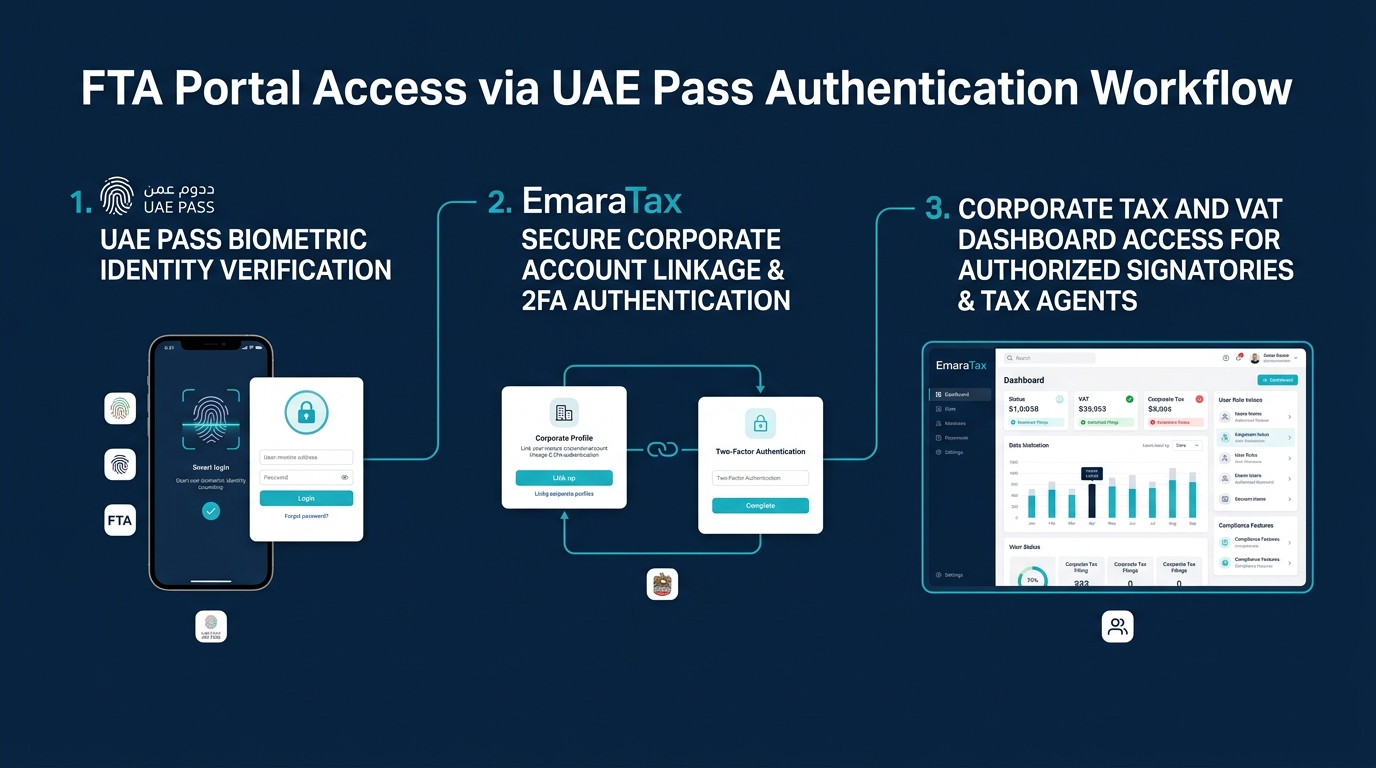
As of September 30, 2024, the UAE Federal Tax Authority (FTA) executed a mandatory transition requiring all corporate taxpayers, sole establishments, tax agents, and legal representatives to access the EmaraTax portal exclusively via UAE Pass. Traditional username and password logins have been permanently superseded by digital biometric authentication.
This statutory integration establishes a high-security Single Sign-On (SSO) gateway across all UAE government services, linking commercial licenses, corporate tax registrations, VAT declarations, and customs clearances directly to verified Emirates ID biometrics.
Executive Summary: Key Takeaways
- Exclusive Digital Gateway: Username and password access for the FTA EmaraTax portal has been fully deprecated. UAE Pass is now the mandatory Single Sign-On (SSO) method for all tax operations.
- Mandatory Biometric Verification: Authorized signatories and company managers must hold a fully verified UAE Pass (upgraded via kiosk or NFC Emirates ID facial recognition) to execute statutory filings.
- Unified Corporate Multi-Entity Linkage: A single verified UAE Pass profile can manage multiple mainland, free zone, and offshore commercial licenses under distinct taxable person profiles.
- Professional Tax Agent Delegation: Business owners can grant granular sub-account permissions to registered tax agents without exposing personal biometrics or master credentials.
02Core Operational & Security Benefits
03Basic vs. Verified UAE Pass Requirements
04Step-by-Step EmaraTax UAE Pass Linkage
05Signatory Roles vs. Tax Agent Delegation
06Common Login Errors & Troubleshooting
07Corporate Tax & VAT Statutory Deadlines
08Frequently Asked Questions (FAQs)
1. Strategic Transition: The Official FTA UAE Pass Mandate
The Federal Tax Authority’s transition to UAE Pass represents a pivotal advancement in the UAE’s national digital economy infrastructure. By eliminating fragmented username-and-password systems, the FTA has integrated national tax administration directly into the world-class digital identity infrastructure governed by the Telecommunications and Digital Government Regulatory Authority (TDRA).
Under this unified framework, every corporate transaction executed within EmaraTax—including VAT return submissions, Corporate Tax registration, excise declarations, and refund requests—carries cryptographically verifiable digital signatures linked directly to the Emirates ID of the authorized signatory.
Official FTA Mandate Notice
Effective September 30, 2024, users must access all services on the EmaraTax platform exclusively using UAE Pass. Taxable persons who previously accessed the portal through standard email and password credentials must link their existing accounts to a verified UAE Pass profile to maintain access continuity.
2. Core Operational & Security Benefits of UAE Pass Integration
The strategic deployment of UAE Pass as the sole authentication mechanism delivers four foundational operational advantages for UAE businesses, tax practitioners, and government regulators:
1. Enhanced Security & Fraud Prevention
UAE Pass leverages advanced asymmetric encryption, biometric facial mapping, and public key infrastructure (PKI) standards. By tying portal logins to physical biometrics, taxable entities are thoroughly safeguarded against unauthorized filings, phishing scams, credential theft, and fraudulent refund diversion.
2. Streamlined Multi-Platform Access
Eliminating the necessity for memorizing separate login credentials across multiple government platforms, UAE Pass provides a unified gateway. Business owners and finance leaders can navigate between the FTA EmaraTax portal, Ministry of Finance portals, Ministry of Economy registries, and municipal licensing authorities with single-click authentication.
3. Operational Efficiency & Administrative Accuracy
Standardized digital identity verification dramatically accelerates account creation and signatory verification. Data recorded on the signatory’s Emirates ID automatically synchronizes with FTA records, eliminating manual document resubmissions and reducing processing queues for corporate registrations and tax amendments.
4. Strategic Alignment with UAE Digital Government Vision
This integration directly supports the UAE Digital Government Strategy 2025 and the Paperless Government initiative. Paper-based powers of attorney and manual signature specimens are replaced with legally binding digital signatures recognized under Federal Decree-Law No. 46 of 2021 on Electronic Transactions and Trust Services.
3. Basic vs. Verified UAE Pass: Critical Requirements for Business
A frequent point of confusion among UAE corporate leaders is the distinction between a Basic UAE Pass account and a Verified (Upgraded) UAE Pass account. While a Basic account permits access to general inquiries and municipal services, the Federal Tax Authority enforces strict security thresholds for corporate actions.
| Feature / Capability | Basic UAE Pass | Verified UAE Pass (Biometric) | FTA Registered Tax Agent Access |
|---|---|---|---|
| Identity Verification Method | Phone number & email self-declaration | Emirates ID NFC scan & biometric facial match | FTA Board certification & licensed credentials |
| Legal Digital Signature (PKI) | Not Available | Legally binding under UAE Federal Law | Authorized digital agent endorsement |
| EmaraTax Corporate Access | Restricted / View Only | Full Corporate Signatory Privileges | Delegated Tax Agency Sub-Account |
| VAT Return & Corporate Tax Filing | Prohibited | Authorized (Primary Signatory) | Authorized (Appointed Agent) |
| Tax Refund Bank Account Verification | Prohibited | Mandatory for Bank IBAN approvals | Assisted Submission / Signatory Approval |
| Multi-License Management | Limited | Unlimited Corporate Linkages | Multi-Client Agency Portfolio |
Important Compliance Warning for Authorized Signatories
If your UAE Pass status is listed as “Basic” (white emblem in the UAE Pass mobile application), EmaraTax will block final corporate tax returns, VAT deregistration, and refund applications. Authorized signatories must upgrade to a “Verified” account (green emblem) using a self-service biometric kiosk or the in-app facial recognition scanner before submission deadlines.
4. Step-by-Step Technical Guide: Upgrading & Linking EmaraTax
To establish a clean, error-free link between your corporate entity and the Federal Tax Authority portal, follow this standardized 4-step deployment methodology:
Step 1: Complete UAE Pass Biometric Verification
Ensure that the company’s designated Authorized Signatory (as named on the Commercial License or Memorandum of Association) possesses an active UAE Pass application on their smartphone. If unverified, scan the physical Emirates ID chip using an NFC-enabled smartphone and complete the live biometric facial scan to obtain the verified green status.
Step 2: Initiate Portal Access via “Sign In with UAE Pass”
Navigate to the official FTA EmaraTax login page and click the prominent “Sign In with UAE Pass” button. Enter the registered Emirates ID, phone number, or email address associated with your UAE Pass. A push notification prompt will immediately display on your smartphone application.
Step 3: Authenticate and Authorize Identity Sharing
Open the UAE Pass app on your mobile device, verify that the authentication request originates from “Federal Tax Authority (FTA)”, and confirm approval using your secure PIN or device biometric (Face ID / Fingerprint). You will then be prompted to approve the secure transfer of verified identity attributes to the FTA system.
Step 4: Reconcile Existing Taxable Person Profiles
Upon initial authentication, EmaraTax prompts users to connect existing taxable person profiles:
- If you already have an EmaraTax account: Select “Link Existing Account”, enter your historical FTA portal email and password once, and verify via 2-Factor Authentication (OTP). Moving forward, the accounts are permanently merged.
- If you are a new corporate registrant: Select “Create New Taxable Person” to establish a corporate tax or VAT registration profile linked directly to your commercial license.
5. Authorized Signatory vs. Tax Agent Delegation Matrix
One of the most critical structural safeguards introduced by the EmaraTax digital framework is granular access delegation. Corporate executives and enterprise boards often ask whether external chartered accountants and tax consultants require the director’s personal UAE Pass credentials. The answer is strictly NO.
EmaraTax features a sophisticated sub-account permission hierarchy designed to maintain strict separation of corporate governance from executive personal identity:
Authorized Signatory Role
The legal director or general manager listed on the trade license or notarized POA. Retains absolute master control over company bank details, tax agent appointment, deregistration, and final legal submissions.
- Maintains master corporate ownership
- Approves tax agent linkage and revocation
- Authorizes government refund bank accounts
FTA Registered Tax Agent Role
Licensed tax professionals registered with the FTA. Appointed through the official “Link Tax Agent” module within EmaraTax, enabling comprehensive preparation of returns without director credential sharing.
- Prepares and files quarterly VAT & Corporate Tax
- Conducts pre-filing audit reconciliations
- Handles official FTA clarification & audit notices
6. Common Login Errors & Troubleshooting Checklist
If your organization encounters access roadblocks during the UAE Pass transition, review this operational diagnostic checklist to restore EmaraTax connectivity:
Email / Mobile Mismatch Errors
- The email address registered in the legacy FTA portal does not correspond with the primary email assigned to your UAE Pass profile.
- Resolution: Log in to the UAE Pass mobile application and update your profile email to match your corporate communication records before attempting account reconciliation.
“Signatory Not Found” Rejection
- The Emirates ID used to authenticate is not listed as a Manager or Authorized Signatory on the current DED / Free Zone Commercial Register.
- Resolution: Submit an official Trade License amendment or upload a valid notarized Power of Attorney (POA) through the EmaraTax user management dashboard.
Expired Emirates ID Suspension
- If an executive’s Emirates ID expires, UAE Pass privileges degrade to unverified status, instantly locking out EmaraTax submission privileges.
- Resolution: Renew the Emirates ID with the Federal Authority for Identity, Citizenship, Customs and Port Security (ICP) and re-authenticate biometrics in the UAE Pass application.
Departing Signatory Lockout
- When a company manager resigns or relocates without transferring master administrator status, the company risks complete tax portal lockout.
- Resolution: Proactively transfer master account ownership in EmaraTax to an active partner or appointed registered tax agent before canceling residency visas.
7. Corporate Tax & VAT Statutory Compliance Deadlines
Maintaining uninterrupted EmaraTax access is vital to fulfilling strict statutory deadlines established under UAE tax legislation:
- UAE Corporate Tax Filings (Federal Decree-Law No. 47 of 2022): Corporate tax returns and payment must be finalized within 9 months following the conclusion of the relevant tax period. Failure to register or submit returns due to portal access delays incurs administrative penalties starting at AED 10,000.
- VAT Return Filings (Federal Decree-Law No. 8 of 2017): Registered businesses must submit periodic VAT returns by the 28th day following the end of their respective tax quarter or month. Late submission triggers mandatory late filing penalties under Cabinet Decision No. 40 of 2017 (as amended).
- Corporate Restructuring & Liquidation: Entities undergoing winding up must obtain a final Tax Clearance Certificate via the portal. Review our comprehensive guide on Company Liquidation Audits in the UAE to align tax deregistration with statutory audit reports.
8. Frequently Asked Questions (FAQs)
Q1
Why did the FTA mandate UAE Pass as the exclusive access method for EmaraTax?
▼
Why did the FTA mandate UAE Pass as the exclusive access method for EmaraTax?
The Federal Tax Authority transitioned to UAE Pass to significantly enhance cybersecurity, prevent corporate identity fraud, streamline government services through a Single Sign-On (SSO) architecture, and guarantee that all tax submissions carry legally recognized digital signatures linked directly to verified Emirates IDs under UAE electronic transaction laws.
Q2
Can businesses still use their legacy username and password to log in to the FTA portal?
▼
Can businesses still use their legacy username and password to log in to the FTA portal?
No. Effective September 30, 2024, traditional email and password login fields have been deprecated. All taxpayers, corporate entities, tax agents, and legal representatives must authenticate through the “Sign In with UAE Pass” gateway.
Q3
What is the difference between a Basic and a Verified UAE Pass for corporate taxpayers?
▼
What is the difference between a Basic and a Verified UAE Pass for corporate taxpayers?
A Basic UAE Pass only verifies email and phone numbers and is limited to basic informational browsing. A Verified UAE Pass requires biometric facial recognition or kiosk physical verification using an Emirates ID. Only a Verified UAE Pass has legal digital signature capabilities and is authorized to submit tax returns, modify licenses, or request VAT refunds on EmaraTax.
Q4
How do I upgrade my UAE Pass to a verified status for corporate tax declarations?
▼
How do I upgrade my UAE Pass to a verified status for corporate tax declarations?
You can upgrade your UAE Pass status in two ways: (1) Inside the UAE Pass mobile application by scanning your Emirates ID chip via NFC and completing the live biometric facial recognition match, or (2) Visiting any self-service UAE Pass kiosk located across shopping malls, government service centers, and municipal offices across the UAE.
Q5
Can one individual’s UAE Pass be linked to multiple company trade licenses?
▼
Can one individual’s UAE Pass be linked to multiple company trade licenses?
Yes. If you are an authorized signatory, shareholder, or manager across multiple mainland, free zone, or offshore entities, your single verified UAE Pass profile can be linked to all corresponding taxable persons within EmaraTax. You can seamlessly switch between different business accounts from the dashboard without logging out.
Q6
What should I do if my registered EmaraTax email does not match my UAE Pass email?
▼
What should I do if my registered EmaraTax email does not match my UAE Pass email?
If your registered EmaraTax email differs from your UAE Pass email, the system may fail to automatically match existing accounts. You should first update your primary email inside the UAE Pass application to align with your corporate tax records, or complete a one-time manual linking verification on the EmaraTax portal using OTP authentication.
Q7
How does an authorized signatory delegate tax return filings to an external tax consultant?
▼
How does an authorized signatory delegate tax return filings to an external tax consultant?
Company directors should NEVER share their personal UAE Pass login credentials or biometrics with third parties. Instead, use the official “Link Tax Agency” or “User Management” feature in EmaraTax. This allows you to appoint an FTA-Registered Tax Agent (such as NUFCA) with specific administrative roles, enabling them to prepare and file returns via their own professional agency portal.
Q8
Is a UAE Pass mandatory for overseas directors and non-resident business owners?
▼
Is a UAE Pass mandatory for overseas directors and non-resident business owners?
Yes. Non-resident business owners and foreign nationals who hold a valid UAE residency visa and Emirates ID can activate UAE Pass abroad. For foreign companies or non-resident taxable persons without an Emirates ID, the FTA provides an exception mechanism allowing authorized legal representatives or licensed UAE tax agents to manage the EmaraTax account on their behalf.
Q9
What happens if our authorized signatory leaves the company or cancels their UAE residency visa?
▼
What happens if our authorized signatory leaves the company or cancels their UAE residency visa?
If a departing signatory’s residency visa is canceled, their UAE Pass privileges will be suspended, potentially locking the company out of EmaraTax. Organizations must proactively designate an additional authorized signatory or appoint a licensed FTA Tax Agent before the departing manager’s visa cancellation is finalized.
Q10
Does the UAE Pass transition change VAT deregistration rules or payment methods?
▼
Does the UAE Pass transition change VAT deregistration rules or payment methods?
No. Core statutory tax rules, VAT deregistration deadlines (within 20 business days of qualifying events), Corporate Tax liabilities, and payment channels (GIBAN, Magnati, credit card) remain strictly identical. The UAE Pass transition solely modernizes identity verification and portal security access.
Explore Related Tax & Assurance Services
Related Practical Guides & Statutory Insights
Need Expert Assistance with FTA EmaraTax or UAE Pass?
NUFCA’s registered tax agents and chartered accountants ensure seamless tax portal access, multi-entity delegation, and 100% statutory compliance across VAT and Corporate Tax mandates.