

JAFZA Approved Auditors in Dubai: A Plain-English Guide for Business Owners

Let’s be honest. Nobody sets up a company in Jebel Ali Free Zone because they’re excited about audits. You came for the location, the ports, the tax setup and the ease of doing business. But once a year, the audit shows up on your to-do list, and how you handle it can make the rest of your year a lot easier or a lot more painful.
This guide walks you through it without the jargon: who needs an audit, who’s allowed to do it, what you’ll need to hand over, roughly what it costs, and how to find an auditor you won’t regret hiring.
Executive Summary / TL;DR
- Mandatory Statutory Filing: FZE, FZCO, and qualifying branch entities registered in JAFZA must submit annual audited financial statements to maintain compliance and renew trade licences.
- Approved Firm Requirement: Only independent audit firms officially listed and approved by JAFZA are eligible to sign off on statutory accounts accepted by the authority.
- Streamlined Handover: Preparing trade licences, MOA/AOA, complete bank statements, trial balance, and VAT filings in one organized folder eliminates up to 80% of audit turnaround delays.
- Auditor Independence: Regular internal accountants handle bookkeeping and day-to-day books; statutory sign-off strictly requires an external, independent approved auditor.
02Does My Company Actually Need One?
03Why It’s Worth Taking Seriously
04What You’ll Need to Hand Over
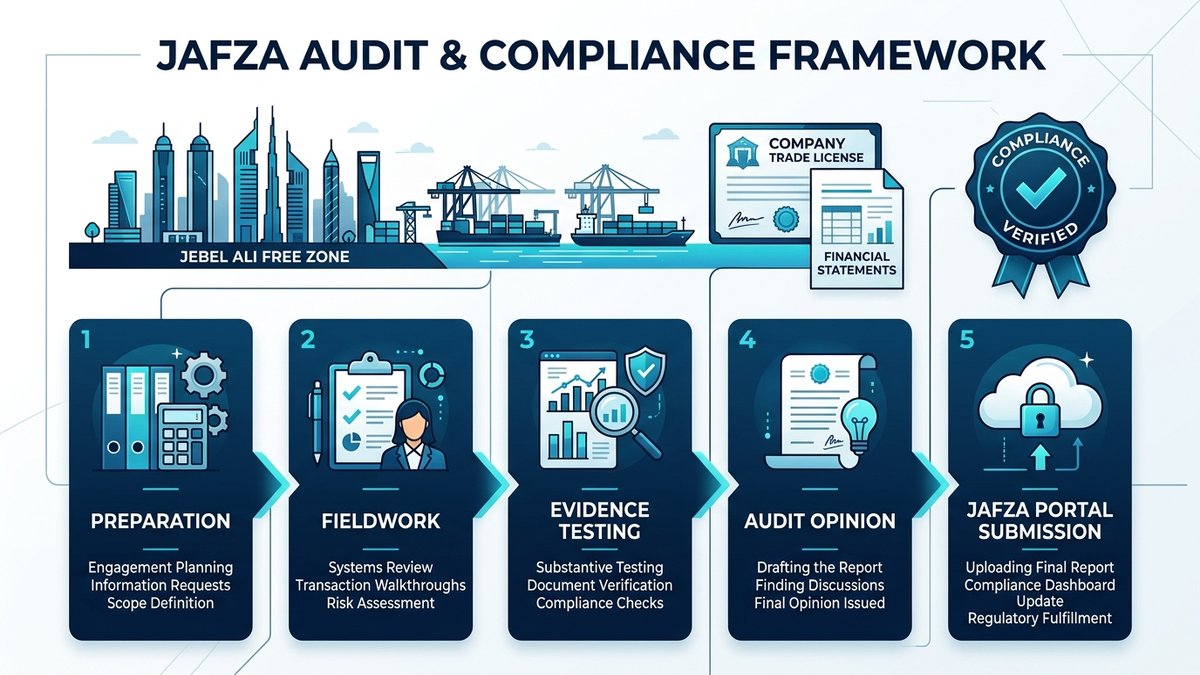
05How the Process Actually Plays Out
06Don’t Leave It to the Last Minute
07A Quick Word on the Rules
08How Much Will It Cost?
09How to Choose an Auditor
10Can’t My Accountant Just Do It?
11Frequently Asked Questions
12The Bottom Line & Action Plan
So, What’s a JAFZA Approved Auditor?
It’s an independent audit firm that JAFZA recognises as eligible to audit companies licensed in the free zone. Not every accountant in Dubai qualifies. The firm has to meet the authority’s criteria before its signature on your accounts counts for anything.
Their main job is simple to describe. They go through your books, test what’s in them, and then give an opinion on whether your financial statements are a fair picture of what actually happened in your business that year.
That said, most good firms do more than the yearly sign-off. Many of them also help with things like:
- Reviewing your accounts during the year, not just at the end
- Tightening up your bookkeeping so next year’s audit goes faster
- Closing audits if you ever decide to wind the company down
- VAT and corporate tax questions
- General advice when you’re unsure how to record something
Does My Company Actually Need One?
In most cases, yes. If you’re running an FZE (one shareholder) or an FZCO (several shareholders) in JAFZA, audited financial statements are normally part of your annual obligations. Other licence types, like branches, can be covered too depending on the rules that apply to them.
If you’re not sure where your company stands, ask early. Finding out two weeks before your deadline is not a fun experience.
Why It’s Worth Taking Seriously
Sure, the audit keeps you compliant. But there’s more to it than that.
When your licence comes up for renewal, you don’t want the audit to be the thing holding everything up. When you approach a bank for a facility, they’ll often ask for audited accounts before they even talk numbers. And a sharp auditor will usually point out weak spots in your bookkeeping or controls that you’d rather hear about from them than discover the hard way.
In short, a clean audit makes you look like a business that has its house in order. Because you do.
What You’ll Need to Hand Over
This is where most delays happen. The auditor can only move as fast as you get them the documents. Here’s what they’ll usually ask for:
| Document | Why They Want It |
|---|---|
| Trade licence | To confirm your company details and activities |
| Certificate of incorporation | To confirm the legal entity |
| MOA and AOA | To see who owns what and how the company is run |
| Bank statements for the full year | To check your cash against your books |
| General ledger and trial balance | The backbone of your financial statements |
| Sales invoices | To back up your revenue |
| Purchase invoices and receipts | To back up your expenses |
| Payroll records | To support staff costs |
| Last year’s audit report | For opening balances and comparisons |
| VAT returns (if you’re registered) | To tie your tax filings to your books |
💡 Practical Advice from Experience
Put all of this in one shared folder, named properly, before the auditor even asks. You’ll be surprised how much quicker things go.
How the Process Actually Plays Out
It’s fairly straightforward once you’ve been through it once:
You Pick Your Auditor
Make sure they’re eligible under JAFZA’s rules and have worked with free zone companies before.
You Share Your Records
Books, bank statements, invoices, and a quick explanation of anything unusual, like a big one-off payment or a loan from a shareholder.
They Do the Checking
The audit team picks samples of transactions, matches them to evidence, confirms balances, and looks at how money moves through your business. Expect questions. That’s normal and it’s a good sign they’re doing their job.
They Issue the Report
Once any corrections are agreed, the auditor signs off their independent opinion.
You File It with JAFZA
The signed accounts and supporting papers go to the authority through its compliance process.
Don’t Leave It to the Last Minute
JAFZA sets a deadline for filing audited accounts, linked to your financial year-end. Check the exact date that applies to you, and put a reminder in your calendar well before it.
The companies that struggle every year tend to have one thing in common. They let their bookkeeping pile up for twelve months and then try to sort it all out in a panic. If you reconcile your accounts monthly, the audit becomes a check rather than a rescue mission. Filing late or filing incomplete paperwork can create problems with your compliance status and slow down other things you need from the authority.
⚠️ Compliance Warning
Missing your filing deadline or submitting incomplete accounts can delay trade licence renewals and interrupt banking access. Maintain monthly ledger reconciliations to keep the audit smooth and predictable.
A Quick Word on the Rules
The requirement to be audited comes from JAFZA’s own regulations, sitting alongside wider UAE rules on company accounts, including the Commercial Companies Law where it applies. What it boils down to is this: keep proper books, prepare yearly financial statements, get them independently audited, and file them the way the authority asks you to.
How Much Will It Cost?
The honest answer is: it depends. There’s no standard price list, because every business is different. The main things that push the fee up or down are:
- How busy your books are: Thousands of transactions take longer to test than a few hundred.
- How big the business is: More entities, more stock, more staff, more work.
- What industry you’re in: Some sectors come with trickier accounting.
- How tidy your records are: This one’s in your control, and it makes a real difference.
- What you actually do: A trading company, a service business and a holding company all get audited differently.
The best approach is to get quotes from two or three firms. Give them your turnover, rough transaction volume and what your business does, and ask for a fixed fee so there are no surprises later.
How to Choose an Auditor You’ll Be Happy With
Price matters, but it shouldn’t be the only thing you look at. Here are a few questions worth asking before you sign anything:
“Can’t My Regular Accountant Just Do It?”
Maybe, maybe not. Plenty of accounting firms are excellent at bookkeeping and VAT returns but aren’t eligible to sign a JAFZA audit. Keeping your books and auditing them are two different jobs, and ideally they shouldn’t be done by the same people anyway, since the whole point of an audit is an independent pair of eyes. Always confirm that the firm is eligible before you hand anything over.
Common Questions We Hear (FAQs)
Q1
Is the audit really mandatory?
▾
For most JAFZA companies, yes. It’s part of the standard yearly compliance routine.
Q2
Can any licensed UAE auditor do it?
▾
No. The firm needs to meet JAFZA’s eligibility requirements.
Q3
How often do we need one?
▾
Once a year, covering each financial year.
Q4
What if we just don’t do it?
▾
You’re likely to run into trouble with your compliance status, which can delay your licence renewal and other services from the authority. It’s not worth the headache.
Q5
Where do I find the current list of approved auditors?
▾
Check directly with JAFZA. They’re the only reliable source for who’s currently eligible.
The Bottom Line
A good auditor won’t just tick a box for you. They’ll make the whole process predictable, keep you on the right side of the authority, and give banks and partners a reason to trust your numbers. Start early, keep your records tidy, and pick a firm that genuinely knows the free zone.
Need a hand with your JAFZA audit this year? Get in touch with our team for a straightforward quote and support from the first document to the final filing.
Related Audit & Assurance Services
Related Practical Guides & Insights
Need a Hand with Your JAFZA Audit This Year?
Contact NUFCA’s registered free zone audit team for a straightforward fixed-fee quote and end-to-end guidance from document preparation to final authority filing.