

Forensic Audit vs Regular Audit: Key Differences and Why They Matter

Audits exist to give organisations confidence in their financial information. However, the term “audit” covers two very different types of work. One is a scheduled review of financial statements; the other is an investigation into whether fraud, financial misconduct, or asset misuse has occurred.
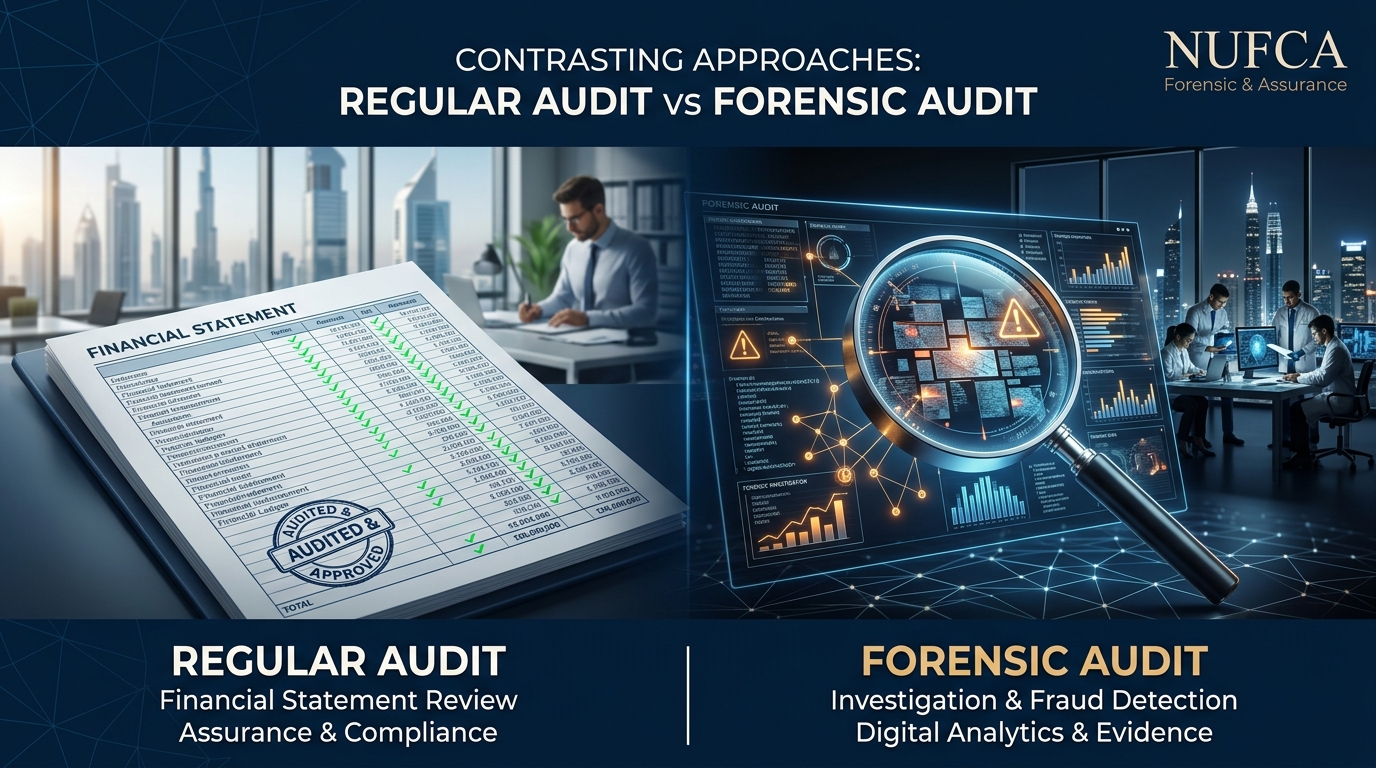
A regular audit evaluates whether financial records are fairly presented and comply with applicable standards. A forensic audit goes further by examining suspected fraud, manipulated records, financial irregularities, and potential misconduct, often with the possibility of regulatory action or legal proceedings in mind.
Understanding when a business requires a forensic audit rather than a regular audit can help protect the organisation when financial concerns develop into serious risks.
Executive Summary / TL;DR
- Distinct Core Objectives: A regular audit provides independent assurance that financial statements comply with IFRS/standards; a forensic audit investigates suspected fraud, asset theft, and intentional manipulation.
- Legal Evidence Standards: Forensic audits collect and preserve evidence under strict legal standards to ensure court admissibility for litigation, arbitration, or regulatory prosecution.
- Investigative Techniques: Regular audits rely on sampling and analytical procedures; forensic audits deploy digital forensics, transaction tracing, Benford’s Law, and interviews.
- Fraud Red Flags: Unexplained cash shortages, lifestyle spikes inconsistent with income, altered electronic records, and unauthorized ledger entries require an immediate forensic inquiry.
Comprehensive Comparison: Forensic Audit vs Regular Audit
To clearly distinguish between statutory compliance reviews and fraud investigations, the key operational and legal parameters are outlined below:
| Comparison Factor | Forensic Audit | Regular Audit |
|---|---|---|
| Primary Objective | Examines suspected fraud, falsified figures, misconduct, theft of assets and similar irregularities. | Provides an independent assessment of whether financial statements fairly represent the organisation’s financial position. |
| Purpose | Identifies evidence, determines responsibility, calculates financial losses, and supports disputes or legal claims. | Confirms compliance with accounting standards, regulations, and internal financial procedures. |
| Trigger for Audit | Usually initiated after allegations, whistleblower reports, suspicious transactions, regulatory concerns, or management suspicion. | Conducted periodically due to statutory requirements, governance practices, or reporting cycles. |
| Scope of Review | Flexible and investigation-led. The scope develops based on evidence discovered during the process. | Defined beforehand according to audit standards, reporting requirements, and engagement terms. |
| Legal Standing | When performed using proper investigative procedures, findings may support litigation, arbitration, insurance claims, or regulatory reviews. | Provides assurance on financial reporting but is not designed to prove fraud or establish liability. |
| Evidence Standards | Requires detailed evidence gathering, documentation, preservation, and analysis suitable for investigative purposes. | Requires sufficient and appropriate evidence to support an audit opinion. |
| Investigative Tools | Uses forensic accounting methods, data analytics, transaction tracing, digital examination, interviews, and fraud investigation techniques. | Uses sampling, reconciliations, confirmations, analytical procedures, substantive testing, and control reviews. |
| Fraud Detection Focus | Specifically designed to uncover fraud schemes, concealment methods, and financial manipulation. | May identify material misstatements or control weaknesses but is not primarily a fraud investigation. |
| Approach | Detective and investigative. The auditor follows evidence trails to determine what occurred and why. | Assurance-focused. The auditor assesses whether financial information is reliable and compliant. |
| Reporting Style | Produces detailed investigative reports containing findings, evidence, and calculated losses. | Produces an audit report providing conclusions on financial reporting accuracy and compliance. |
| Professionals Involved | Forensic accountants, fraud examiners, investigators, data specialists, and legal professionals. | Internal auditors, external auditors, and accounting professionals. |
Key Differences Explained
1. Objective: Investigation vs Assurance
A regular audit focuses on questions such as:
- Do the financial statements accurately represent the organisation’s position?
- Are accounting policies being applied correctly?
- Are internal controls operating effectively?
A forensic audit addresses deeper investigative questions:
- Did fraud or misconduct occur?
- Who was involved?
- How were funds transferred or records manipulated?
- What financial losses resulted?
Forensic accountants combine accounting expertise with investigative methods. Their role is not only to identify financial irregularities but also to present complex findings in a clear format that management, regulators, arbitrators, or courts can understand.
2. Evidence Collection and Legal Use
The handling of evidence is one of the biggest differences between the two audit types.
A regular audit collects evidence that is sufficient to support an independent audit opinion. A forensic audit requires a more investigative approach, where evidence must be carefully collected, preserved, and connected to specific allegations.
Key evidence practices include:
- Maintaining complete documentation trails
- Preserving electronic records
- Reconstructing transaction histories
- Conducting structured interviews
- Linking evidence to suspected misconduct
This approach allows forensic audit findings to support insurance claims, regulatory investigations, arbitration proceedings, or court matters.
3. Investigative Techniques and Tools
A forensic audit may involve:
- Tracing funds through accounts and entities
- Digital forensic examination and recovery
- Reviewing emails and document records
- Benford’s Law analysis for unusual numerical patterns
- Data mining and anomaly detection
- Reviewing related-party transactions
- Interviewing employees and management
A regular audit typically relies on:
- Sampling methods
- Account reconciliations
- External confirmations
- Internal control assessments
- Testing of financial statement balances
Red Flags That May Require a Forensic Audit
Fraud is often identified through patterns rather than a single event. Several unusual indicators appearing together may justify a deeper investigation.
💰 Financial Irregularities
- Unexplained cash shortages or missing funds
- Sudden revenue, cost, or margin changes without operational reasons
- Duplicate payments or unusual vendor transactions
- Financial entries without proper supporting documents
- Significant unexplained write-offs
👤 Employee or Management Concerns
- Lifestyle changes inconsistent with known income
- Excessive control concentrated with one individual
- Resistance to financial reviews or transparency requests
- Transactions approved outside authorised limits
- Undisclosed relationships with suppliers or contractors
📑 Accounting and Reporting Issues
- Frequent late adjustments to accounting records
- Missing invoices, contracts, or receipts
- Financial statements showing signs of manipulation
- Unusual related-party transactions
- Differences between operational records and accounting data
💻 Digital and Data Warning Signs
- Financial files deleted or altered without explanation
- Unauthorised system access
- Changes made to previously recorded transactions
- Suspicious login activity
- Attempts to remove digital evidence
Diagnostic Advisory
A single warning sign may have a legitimate explanation. However, multiple indicators appearing together can signal the need for a targeted forensic review.
When Should a Business Choose a Forensic Audit?
A forensic audit is usually considered when an organisation needs to determine whether misconduct occurred, measure financial losses, support a legal claim or defence, or identify weaknesses that allowed irregularities to happen.
Businesses requiring specialist investigative support can explore forensic audit services in UAE to understand how forensic professionals investigate fraud risks, analyse financial evidence, and strengthen internal controls.
Final Thoughts & Governance
Forensic audits and regular audits serve different purposes and should not be treated as interchangeable services.
A regular audit provides assurance that financial statements are accurate and compliant. A forensic audit investigates whether something has gone wrong and gathers evidence to explain what happened, who was involved, and the financial impact.
The right choice depends on the business objective. When the goal is financial assurance, a regular audit is appropriate. When there are concerns involving fraud, disputes, unexplained losses, or suspicious financial activity, a forensic audit provides the investigative depth required.
Frequently Asked Questions
Q1 What is the primary difference between a forensic audit and a regular audit?
▾
A regular statutory audit provides reasonable assurance that financial statements are free from material misstatements and comply with accounting standards. A forensic audit is an investigative examination specifically designed to detect fraud, identify perpetrators, quantify financial losses, and secure evidence for legal or disciplinary proceedings.
Q2 Can a regular statutory audit detect fraud?
▾
While external auditors remain alert to fraud risks (under ISA 240), a regular audit relies primarily on sampling and test checking. It is not designed to uncover sophisticated, concealed fraud schemes or collusive corruption, which require the targeted forensic procedures of a dedicated forensic investigation.
Q3 Are forensic audit reports admissible in UAE courts and arbitration?
▾
Yes. When conducted by licensed UAE chartered accountants and certified fraud specialists adhering to strict chain-of-custody protocols, forensic audit reports can serve as expert evidence before UAE civil and criminal courts, Dubai International Arbitration Centre (DIAC), and other regulatory tribunals.
Q4 How does the scope of a forensic audit differ from a financial audit?
▾
A regular audit follows a predefined, standardized scope dictated by International Standards on Auditing (ISA) and the reporting calendar. A forensic audit has a dynamic, hypothesis-driven scope that adapts as new investigative leads, transactions, or communications emerge.
Q5 What common triggers prompt a company to commission a forensic audit?
▾
Typical triggers include whistleblower allegations, unexplained inventory or cash variances, suspicious vendor transactions, shareholder or partnership disputes, suspected breach of fiduciary duty by executives, and regulatory inquiries.
Related Audit & Assurance Services
Related Practical Articles & Guides
Concerned About Financial Discrepancies or Irregularities?
Connect confidentially with NUFCA’s forensic accountants and certified fraud specialists across Dubai and the UAE for independent financial investigations, transaction tracing, and dispute support.