

Bookkeeping Services in Dubai, UAE: Regulatory Framework, Statutory Retention & Practical Guide

Your books are no longer just an internal record. There was a time when a Dubai business could get by with a shoebox of receipts and a spreadsheet tidied up once a year. That period has ended.
Between Corporate Tax, VAT, statutory retention rules and the Electronic Invoicing System now rolling out across the country, the ledger a company keeps day to day has become the evidence base it will be assessed on.
NUF Chartered Accountants maintains that evidence base for startups, SMEs, established groups and businesses across a range of sectors in Dubai. We handle the recording, reconciling and reporting so the finance function produces something management can actually use — and something that stands up when a regulator, auditor, lender or investor asks to see it.
Some clients come to us for steady monthly bookkeeping. Others arrive with eighteen months of untouched bank statements and a VAT deadline approaching. Both situations are workable. What matters is getting to a point where the numbers are current, reconciled and traceable back to source documents.
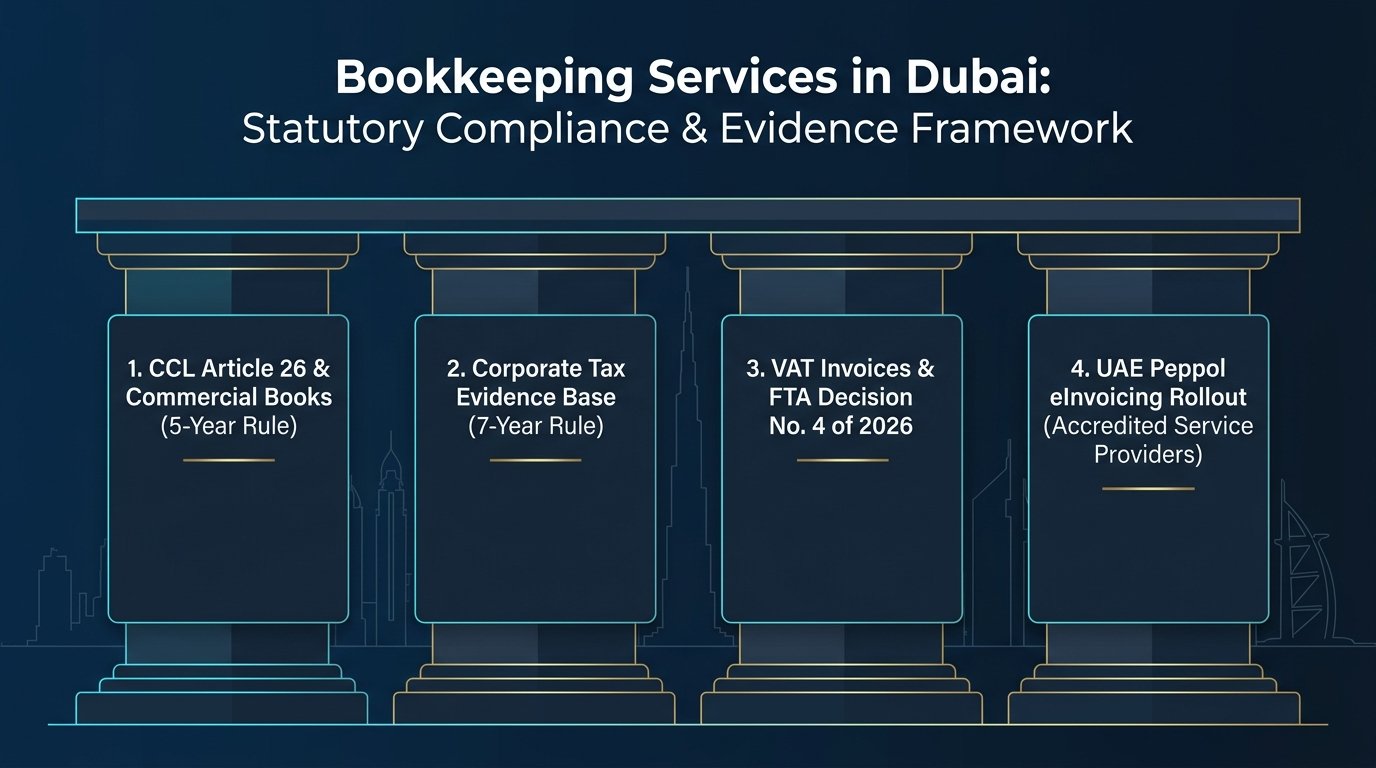
Executive Summary / TL;DR
- Commercial Companies Law (Art. 26): Mandates a minimum 5-year retention period from the close of the financial year for all accounting records at the company’s head office.
- Corporate Tax Record Retention (7 Years): Federal Tax Authority (FTA) requires all supporting tax documents to be retained for at least 7 years after the Tax Period ends.
- Mandatory eInvoicing Roadmap: Businesses with revenue ≥ AED 50M must appoint an ASP by 30 October 2026 (live 1 Jan 2027); businesses < AED 50M must appoint by 31 March 2027 (live 1 July 2027).
- Uncompromised Evidence Base: Structured monthly bookkeeping provides the essential audit trail required to defend VAT filings, corporate tax computations, and bank credit facilities.
02UAE eInvoicing Rollout Timetable
03Scope of Bookkeeping Services
045-Step Engagement Methodology
05Required Documentation
06Mainland vs Free Zone Entities
07Bookkeeping vs Accounting
08In-House vs Outsourcing Matrix
09Cost Determinants & Pricing
10Frequently Asked Questions
What the UAE Actually Requires You to Keep
Before discussing the scope of work, it helps to be clear on the legal baseline. Three separate obligations apply, and they do not share the same retention period.
Commercial Companies Law — Article 26
Federal Decree-Law No. 32 of 2021 obliges every company to keep accounting records that present a truthful picture of its transactions and financial position.
Those records must be held at the company’s head office for a minimum of five years after the close of the financial year they relate to.
The practical reading of “truthful picture” is that scattered spreadsheets, a folder of PDFs and an online banking login do not constitute proper accounting records. The information has to be organised and retrievable.
Corporate Tax
The Federal Tax Authority expects records and supporting documents connected to Corporate Tax to be kept for at least seven years after the end of the relevant Tax Period — two years longer than the Companies Law baseline.
Revenue figures, deductible expenses, related-party dealings and adjustments all need underlying documentation that supports whatever position was filed.
VAT
Registered businesses must retain tax invoices issued and received for a minimum of five years.
The ability to connect a VAT return line back to the invoice, the payment and the ledger entry behind it is the whole point of the requirement.
The FTA has also issued Decision No. 4 of 2026 covering the rules and requirements for maintaining information held in accounting records and commercial books — a reminder that record-maintenance standards are being tightened rather than relaxed.
| Obligation | Minimum Retention | Counted From |
|---|---|---|
| Accounting records — Article 26 | 5 years | End of the financial year |
| Corporate Tax records | 7 years | End of the Tax Period |
| VAT invoices issued and received | 5 years | Date of the invoice |
Practical Takeaway
Build the retention policy around the seven-year Corporate Tax requirement. Meeting the longest obligation automatically satisfies the shorter ones.
eInvoicing: What Changes, and When
The UAE’s Electronic Invoicing System is moving from framework to live operation, and it will reshape how invoice data enters your books.
The Ministry of Finance opened the pilot programme on 1 July 2026, running with an invited taxpayer working group alongside Accredited Service Providers (ASPs). Voluntary adoption became available from the same date.
The mandatory phases follow this sequence:
| Group | Appoint an ASP by | System Live From |
|---|---|---|
| Revenue of AED 50 million or more | 30 October 2026 | 1 January 2027 |
| Revenue below AED 50 million | 31 March 2027 | 1 July 2027 |
| Government entities | 31 March 2027 | 1 October 2027 |
Statutory Deadline Clarification
The October 2026 appointment deadline for larger businesses replaced an earlier date of 31 July 2026, amended through Ministerial Decision No. 66 of 2026. Crucially, the January 2027 go-live date was not moved — the extension bought time to choose a provider, not time to implement.
Intra-group transactions carry a transition period running to 1 January 2029.
Under the UAE’s Peppol-based model, a structured electronic document exchanged through an ASP is the valid invoice. A PDF emailed to a customer does not qualify.
This matters for bookkeeping in a specific way: once invoices are structured data flowing through an accredited channel, the quality of your master data — customer records, supplier records, tax codes and item descriptions — stops being an internal housekeeping matter and starts determining whether documents transmit successfully.
Businesses whose ledgers are messy today will feel that most.
What We Do
No two companies need identical treatment. Transaction count, sector, entity structure and reporting expectations all shift the workload. The components below are assembled to fit.
Transaction Recording and Classification
Everything downstream depends on this being right. We capture and correctly categorise:
- Sales and revenue entries
- Purchases and cost of sales
- Operating expenses
- Payments to suppliers
- Receipts from customers
- Bank movements and cash transactions
- Journal entries and adjustments
Consistent classification produces a general ledger that can be interrogated later — rather than one that has to be rebuilt before anyone can use it.
Bank and Credit Card Reconciliation
Ledger balances are checked against statements on a regular cycle. Reconciliation is where problems surface early:
- Transactions that never made it into the system
- Duplicated entries
- Bank charges and fees not accounted for
- Payment mismatches and timing differences
- Receipts that were never provided
It also gives management something more reliable than an online banking balance: an accurate view of the company’s real cash position.
Receivables
Knowing what customers owe, and for how long, is a cash-flow discipline as much as an accounting one. We maintain invoice records, applied receipts, credit notes, outstanding balances and ageing analysis so overdue accounts are visible before they become collection problems.
Payables
The same discipline applies to the other side of the ledger — supplier invoices, payments made, credit notes, open balances, payable ageing and periodic reconciliation against supplier statements. Accurate payables let you plan payment runs and protect supplier relationships instead of reacting to chasers.
VAT-Ready Records
Returns are only as defensible as the records behind them. We organise and record tax invoices issued and received, taxable sales, deductible expenses, input and output VAT, credit notes and supporting documentation as part of the routine monthly cycle.
Maintaining this continuously — rather than assembling it in the week before a filing deadline — substantially reduces the corrective work required when a return falls due or the FTA asks questions.
Monthly Reporting
Bookkeeping that only produces a historical record is doing half its job. Depending on what management needs, the records can support:
- Trial balance
- Profit and loss statement
- Balance sheet
- Receivables and payables ageing
- Expense analysis
- Cash-flow information
- General ledger detail
Monthly visibility lets you catch a margin slipping or a cost drifting while there is still time to respond.
Catch-Up and Backlog Work
Falling behind is common, and rarely a sign of poor management. Rapid growth, a finance hire leaving, missing paperwork or an inconsistent process will do it.
Bringing books current typically involves reviewing what exists, entering the gaps, reconciling every bank account across the affected periods, correcting misclassified entries, verifying customer and supplier balances, assembling supporting documents and carrying the records forward to the present period.
Companies facing an audit, VAT review, Corporate Tax filing, financing application or investor due diligence generally find this work unavoidable — and considerably less painful when started early.
How the Engagement Runs
Our systematic 5-step methodology ensures seamless transition, comprehensive document capture, and audit-grade reconciliations:
Assess What Exists
We look at the current accounting records, bank accounts, customer and supplier ledgers, outstanding reconciliations, available documentation and how reporting has been handled so far. This determines the real scope.
Collect and Organise Source Documents
Sales and purchase invoices, receipts, bank and card statements, payment records, supplier and customer statements, payroll data and contracts. The objective is a coherent audit trail, not a full filing cabinet.
Record and Classify
Transactions are entered under consistent categories so period-on-period comparison actually means something.
Reconcile and Review
Bank balances, customer accounts, supplier accounts and other ledger balances are checked. Discrepancies are investigated rather than written off.
Close and Report
With records updated and reconciled, the period is closed and the information becomes available for management reporting, VAT filing, Corporate Tax work, audit preparation and planning.
Documents We Typically Need
Setting up a routine for getting paperwork to us — monthly, not annually — removes most of the friction from this process.
Standard Document Checklist
Bank statements • Sales invoices • Purchase invoices • Expense receipts • Supplier and customer statements • Credit and debit notes • Petty cash records • Payment vouchers • Payroll information • Fixed asset purchase documentation • Loan statements • Contracts • VAT records
Mainland and Free Zone Entities
Dubai businesses operate under a range of structures, and the reporting, audit and tax obligations attached to each differ by licensing authority, activity and tax position.
The bookkeeping requirement itself, however, is constant: every entity needs financial records it can rely on and produce on request.
We support mainland companies, free zone entities, early-stage businesses, SMEs, trading companies, professional and consulting firms, e-commerce operations and companies whose transaction volumes have outgrown their existing setup.
The approach should follow the business. A trading company clearing hundreds of purchase invoices a month has little in common, operationally, with a two-partner consultancy — and should not be handled as though it does.
Bookkeeping and Accounting: Where the Line Sits
The terms get used interchangeably. They describe different work.
| Dimension | Bookkeeping | Accounting |
|---|---|---|
| Purpose | Capture and organise transactions | Interpret and report on financial information |
| Core Activity | Entries, ledgers and reconciliations | Statements, adjustments and analysis |
| Rhythm | Continuous | Monthly, quarterly or annual |
| Output | Complete, reconciled records | Financial statements and insight |
| Dependency | Produces the source data | Consumes it |
The relationship runs one way. Accounting cannot correct for bookkeeping that was wrong at the point of entry — a misclassified expense or an unrecorded invoice carries straight through into the financial statements, tax computation and management pack.
Keeping It In-House or Outsourcing
When structuring your accounting department, choosing between hiring full-time staff and appointing an external firm involves operational trade-offs:
| Consideration | In-House | Outsourced |
|---|---|---|
| Resourcing | Employed staff | External professional team |
| Cost Structure | Salary, visa, benefits, leave and training | Agreed scope and fee |
| Expertise | Limited to who you hire | Broader base across clients and sectors |
| Scaling | Growth means recruitment | Scope adjusts with volume |
| Continuity | Exposed if a key person leaves | Team coverage |
| Oversight Needed | Ongoing supervision | Minimal day-to-day involvement |
Neither is universally better. Weigh transaction volume, complexity, how much reporting you need, what finance capability already exists internally and total cost — not just the headline fee.
Why Companies Outsource
Outsourcing tends to make sense for businesses that need professional accounting capability without standing up a full finance department.
The usual gains are experienced people on the work, a process that runs consistently rather than in bursts, reconciliations that actually happen, clearer receivables and payables visibility, records that hold up for VAT and Corporate Tax purposes, capacity that flexes with volume, and management time returned to the business.
Worth Noting
The goal is not simply to move administrative work off someone’s desk. If the arrangement does not give management better information to make decisions with, it has only relocated the problem.
What It Costs
There is no standard price, and any firm quoting one before looking at your records is guessing.
Fees are driven by monthly transaction volume, the number of bank accounts, invoice counts on both sides, VAT registration status, the size of your customer and supplier base, transactional complexity, reporting frequency, the current state of the books, whether historical periods need correcting, how many entities are involved and what additional tax or accounting support you need.
A consultancy with forty transactions a month sits in a different bracket from a trading business processing purchases, sales, payments and inventory movements daily.
A realistic quotation follows a review of your existing records and expected volumes — not a phone call.
Why NUF Chartered Accountants
Selecting a bookkeeping provider on price alone is a false economy that usually reveals itself at year-end.
What is worth looking for is a firm that understands UAE accounting, tax and regulatory requirements in practice, and that can continue to support the business as it grows and its obligations expand.
NUF Chartered Accountants provides accounting and bookkeeping services to businesses across the UAE, with a presence in Bur Dubai, DMCC/JLT, Gold Souk/Deira and Dubai Airport Freezone (DAFZA).
Engaging a chartered accounting firm rather than a data-entry service means the records are maintained with an understanding of what they will eventually be used for — and that wider accounting, tax and compliance support is available when it is needed.
Frequently Asked Questions
Q1 What is included in bookkeeping services in Dubai?
▾
Typically: recording transactions, maintaining the general ledger, reconciling bank and card accounts, managing receivable and payable records, classifying expenses, organising VAT documentation and producing periodic financial information.
The precise scope is set by the size and needs of the business.
Q2 Is bookkeeping mandatory in Dubai?
▾
Yes. UAE company legislation requires companies to keep accounting records presenting a truthful picture of their transactions and financial position, and Article 26 of Federal Decree-Law No. 32 of 2021 requires those records to be retained for at least five years after the relevant financial year ends.
Q3 How long must records be kept?
▾
It depends on which obligation applies.
Article 26 sets five years from the end of the financial year. Corporate Tax records should be kept for at least seven years after the relevant Tax Period. VAT invoices issued and received require five years.
Applying the seven-year standard across the board is the simplest approach.
Q4 What separates bookkeeping from accounting?
▾
Bookkeeping records, organises and reconciles. Accounting takes those records and produces reporting, analysis, adjustments and compliance outputs.
One feeds the other.
Q5 Can bookkeeping be outsourced in Dubai?
▾
Yes, and many companies do so rather than employ internal staff for it.
Suitability comes down to company size, transaction volume and existing finance resources.
Q6 Can books that are years behind be brought up to date?
▾
Yes.
Catch-up work involves reconstructing historical periods — entering missing transactions, completing reconciliations, correcting classifications and resolving inconsistencies until the accounts reach the current period.
Q7 How often should bookkeeping be done?
▾
Match it to activity level and reporting needs.
Businesses with a steady transaction flow benefit from continuous updating within each month. Leaving everything until quarter-end or year-end produces rushed work and avoidable errors.
Q8 Does good bookkeeping help with VAT and Corporate Tax?
▾
Directly.
Both depend on reliable underlying data. Organised records of revenue, expenses, invoices and supporting documentation are what you fall back on when preparing a filing or responding to a query from the FTA.
Q9 Do free zone companies need to keep books?
▾
Yes.
Free zone entities are required to maintain appropriate accounting records, although the specific audit, reporting and tax obligations vary by free zone, entity type, activity and applicable legislation.
Q10 When does it make sense to bring in a professional?
▾
Common triggers include transaction volume outgrowing the current setup, records slipping behind, reconciliations being left incomplete, management being unable to obtain reliable reports, or an approaching requirement around VAT, Corporate Tax, audit or financing.
Getting Started
Reliable bookkeeping is the foundation everything else rests on — tax compliance, audit readiness, financing conversations and the decisions management makes in between.
The alternative is discovering the gaps during a VAT review, Corporate Tax filing, audit or year-end close, when the time to fix them properly has already gone.
If your business needs bookkeeping support in Dubai, NUF Chartered Accountants can take on the work of keeping your records structured, accurate and current.
Contact NUF Chartered Accountants to discuss your requirements and receive a scope and quotation based on your actual activity and transaction volume.
Related Accounting & Advisory Services
Related Practical Articles & Guides
Need Reliable Bookkeeping for Your Dubai Business?
Speak directly with our chartered accounting team. We review your bank accounts, transaction volumes, and tax obligations to deliver an accurate, transparent bookkeeping scope.