

Accounting Services for Small Business in Dubai, UAE: Why They Matter in 2026

Building a small business in Dubai asks far more of an owner than closing deals and watching overheads. There are books to keep straight, cash movement to track, VAT and Corporate Tax obligations to satisfy, and a fast-approaching shift towards digital tax reporting to prepare for.
Which is exactly why professional accounting services for small business in Dubai now sit close to the centre of running a company here. Well-kept accounts show an owner precisely where the business stands, while producing the evidence needed for tax filings, audits, financing conversations and growth plans.
For startups, SMEs and owner-managed firms, handing the work to an external team also opens access to seasoned professionals without the cost of building an internal finance function.
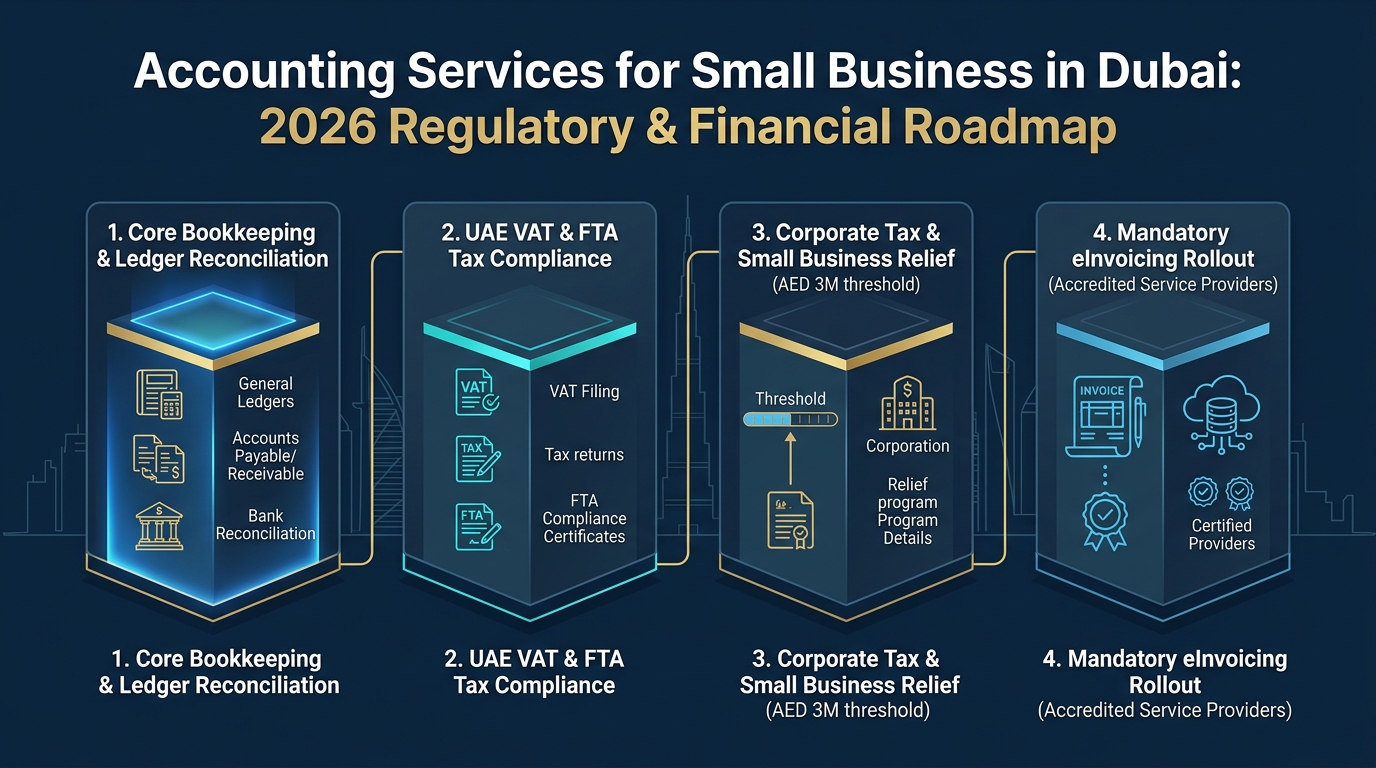
Executive Summary / TL;DR
- Statutory Tax Mandate: Accurate accounting is the legal foundation for UAE VAT filings (AED 375k threshold) and Corporate Tax calculations (0% up to AED 375k, 9% standard rate).
- Small Business Relief Extended to 2029: Eligible resident businesses with revenue up to AED 3 million can claim tax relief, but require meticulous accounting records to substantiate eligibility.
- Mandatory eInvoicing Roadmap: Businesses under AED 50M revenue must appoint an Accredited Service Provider by 31 March 2027 and go live by 1 July 2027.
- Strategic Cost & Liquidity Control: Professional monthly accounts flag ageing receivables, control overhead creep, and prepare books for banking facilities and investor due diligence.
02Why Dubai SMEs Need Professional Support
03VAT Accounting & FTA Compliance
04Corporate Tax Accounting & Records
05Small Business Relief: 2026 Update
06UAE eInvoicing: Mandatory Rollout
07Controlling Costs & Driving Growth
08Funding, Investment & Due Diligence
09Outsourcing Advantages & Selection
10Frequently Asked Questions
What Are Accounting Services for Small Businesses in Dubai?
Small business accounting services generally span the recording, reconciliation, reporting and compliance work that keeps a company’s financial picture accurate and current.
Depending on the business, accounting services in Dubai may take in:
- Bookkeeping and general ledger maintenance to ensure every entry is chronologically captured.
- Accounts payable and accounts receivable management to balance supplier credit and client collections.
- Bank and credit card reconciliation to eliminate ledger variances and unauthorized charges.
- Preparation of financial statements including Balance Sheets, Income Statements, and Cash Flow summaries.
- Cash-flow reporting for operational solvency and working capital planning.
- VAT registration, record keeping and return preparation aligned with Federal Tax Authority (FTA) mandates.
- Corporate Tax accounting and compliance support covering deductible vs non-deductible adjustments.
- Payroll accounting ensuring statutory compliance with the UAE Wages Protection System (WPS).
- Expense classification and management reporting identifying cost inefficiencies.
- Audit preparation and supporting schedules facilitating smooth year-end statutory assurance.
- Accounting system setup and oversight across cloud platforms such as Zoho Books, Xero, QuickBooks, and ERP modules.
- Budgeting and financial forecasting to guide sustainable business expansion.
The right scope reflects the company’s size, sector, transaction volume and regulatory position — nothing more, nothing less.
Why Do Small Businesses in Dubai Need Professional Accounting Services?
Smaller companies almost always run lean on finance and administrative capacity. Early on, most owners keep the books themselves or lean heavily on accounting software to fill the gap.
Software handles a great deal. But the accuracy of any report still depends on whether each transaction was captured, categorised and reconciled properly to begin with.
Professional support helps a business establish records it can rely on, surface errors before they multiply, and hand management information worth acting on.
Maintain Accurate Financial Records
Everything downstream rests on the quality of the entries beneath it.
Sales, purchases, expenses, payments, receivables, liabilities and bank activity all need capturing in a consistent way. Where entries are missing or sitting in the wrong account, the reports that follow mislead rather than inform.
Professional accountants work the books on a regular cycle and tie them back to bank statements, invoices and other supporting documents. What emerges is a far truer view of how the company is actually trading.
Manage Cash Flow and Customer Payments
Profit on paper and cash in the bank are two separate things. Revenue can look healthy while liquidity tightens, simply because customers have not settled their invoices.
Disciplined accounting keeps the following in plain sight:
- Outstanding customer invoices
- Ageing receivables
- Supplier payments falling due
- Recurring expenses
- Bank balances
- Short-term liabilities
- Expected inflows and outflows
Routine receivables reporting flags overdue invoices early and sharpens the collection process behind them. In a small business, where a handful of late payments can stall operations, that visibility is worth a great deal.
Accounting and VAT Compliance for Small Businesses in Dubai
VAT remains a standing accounting responsibility for businesses across the UAE.
A UAE-resident business is generally obliged to register for VAT once taxable supplies and imports pass AED 375,000 across the preceding 12 months, or where that figure is expected to be exceeded within the next 30 days. Voluntary registration is generally open to eligible businesses whose applicable taxable supplies, imports or expenses exceed AED 187,500.
Statutory Threshold Notice
Once registered, the accounting records must cleanly separate taxable, zero-rated, exempt and other relevant categories of transaction. Tax invoices generally have to be retained for the statutory period (typically 5 to 7 years), which puts a premium on records that are organised rather than merely present.
Accounting support typically covers:
- Classifying transactions for correct VAT treatment (5% standard rate, 0% export/qualifying rate, exempt)
- Maintaining compliant tax invoice and credit note records
- Reconciling input tax against output VAT collected
- Preparing and submitting periodic VAT returns on the EmaraTax portal
- Reviewing the supporting documentation for valid commercial justification
- Agreeing submitted returns back to the general ledger
Corporate Tax Accounting for Small Businesses in Dubai
Describing the UAE as a place where VAT is a company’s only tax concern no longer holds true. The UAE Corporate Tax regime applies to tax periods commencing on or after 1 June 2023 under Federal Decree-Law No. 47 of 2022.
For businesses falling under the standard rates, taxable income up to AED 375,000 is generally charged at 0%, with taxable income above that threshold generally charged at 9%.
Accounting sits directly in this chain, because accounting income normally forms the starting point for working out taxable income — subject to whatever adjustments the legislation requires.
Businesses often need professional help with:
- Keeping accounting records that are Corporate Tax-ready
- Preparing annual financial statements conforming to recognized accounting standards (IFRS / IFRS for SMEs)
- Separating deductible business expenses from non-deductible items (such as entertainment caps and fines)
- Reconciling accounting net profit to adjusted taxable income
- Building and maintaining the supporting statutory schedules
- Preparing and filing the Corporate Tax return itself
- Holding the accounting records the Federal Tax Authority expects upon audit
Filing Deadlines & Statutory Record Retention
Taxable Persons are generally required to file their Corporate Tax Return and settle any tax payable within nine months of the relevant Tax Period ending. Furthermore, Corporate Tax records and supporting documents must be retained for at least seven (7) years after the close of the Tax Period they belong to.
Small Business Relief: Important 2026 Update
Smaller companies should also test whether they meet the conditions for UAE Small Business Relief.
August 2026 Ministry of Finance Extension
In August 2026, the UAE Ministry of Finance announced an extension to Small Business Relief. Subject to the applicable conditions, eligible Resident Persons with revenue not exceeding AED 3 million in the relevant and previous tax periods may continue claiming the relief for qualifying Tax Periods ending on or before 31 December 2029.
The relief can genuinely simplify Corporate Tax compliance for those who qualify, treating the taxable person as having no taxable income for that period. It is not, however, permission to let the bookkeeping slide.
A business still needs dependable records to establish its revenue, evidence its eligibility and meet the filing and retention requirements that continue to apply. Eligibility is best reviewed for each Tax Period in turn, rather than assumed on the basis that the company thinks of itself as small.
UAE eInvoicing: What Small Businesses Need to Prepare For
The other significant change facing Dubai businesses is the UAE Electronic Invoicing System (E-Invoicing Framework).
The UAE’s eInvoicing pilot and voluntary adoption phase began on 1 July 2026. The mandatory rollout is arriving in stages:
SME Implementation Timetable
Under the current timetable, in-scope businesses with annual revenue below AED 50 million are expected to:
- Appoint an Accredited Service Provider (ASP): By 31 March 2027.
- Fully Operationalize the Electronic Invoicing System: From 1 July 2027.
The framework covers relevant B2B (business-to-business) and B2G (business-to-government) transactions, subject to the exclusions set out in the applicable rules.
For a small business, that puts real weight on how ready the accounting system actually is. It is well worth checking whether your current accounting or ERP platform can handle:
- Structured electronic invoice data in XML/JSON formats
- Accurate customer and supplier master records including verified TRNs and corporate identifiers
- Consistent tax coding across all product and service line items
- Direct API integration with an Accredited Service Provider (ASP)
- Tamper-proof digital transaction records and audit logs
- Automated invoice reconciliation and real-time FTA reporting
Tidying the underlying data now makes the eventual switch considerably less disruptive.
How Accounting Services Help Small Businesses Control Costs
Compliance is only half of what good accounting delivers. Detailed financial information shows an owner where the money is genuinely going, and whether costs are outpacing revenue growth.
Management reporting tends to bring things like this to the surface:
- Supplier pricing creeping upward without renegotiation
- Overheads disproportionate to monthly turnover
- Products or service lines running on razor-thin or negative margins
- Discretionary business expenses drifting without managerial oversight
- Slow-moving inventory that is tying up working capital
- Debtor days steadily lengthening, indicating lax collection controls
With reliable monthly accounts in hand, an owner can measure results against budget and adjust while the problem is still small.
Accounting Helps Small Businesses Make Better Growth Decisions
Expansion needs financial groundwork beneath it. Before adding headcount, opening a second branch, building inventory or committing to equipment leases, management should understand what the decision does to the numbers.
Proper accounting gives visibility over:
Operational Health Metrics
Clean revenue trends, gross and net profit margins, working capital adequacy, and liquidity ratios.
Financial Risk Metrics
Cash availability, existing debt commitments, fixed vs. variable cost split, and exact break-even levels.
Read together, these tell an owner whether a growth plan is financially sustainable or simply appealing.
Accounting Records Can Support Funding, Investment and Business Sales
Even with no immediate plan to raise capital, clean accounts earn their keep later.
Banks, investors, prospective partners and buyers almost always want credible financial information before releasing funds, extending trade credit, or signing acquisition terms. Disorganised books slow due diligence badly and make it hard to demonstrate what the business has actually achieved over time.
Keeping accurate records from the outset means the information is ready the moment an opportunity appears.
Should a Small Business Outsource Accounting in Dubai?
For a great many SMEs, outsourcing proves far more practical than assembling and maintaining an in-house accounting department. An external firm provides access to experienced professionals while letting the business scale the support up or down as circumstances change.
Outsourcing makes particular sense where a business:
- Cannot justify the salary, visa, and workstation cost of a full-time in-house accountant
- Is handling rising transaction volumes that outgrow manual spreadsheets
- Needs consistent monthly financial and management reporting
- Requires technical VAT and Corporate Tax compliance support
- Has fallen behind on historical bookkeeping and needs urgent backlog clearing
- Needs accounts professionally prepared ahead of an external statutory audit
- Wants firmer financial controls and segregation of accounting duties
- Is preparing infrastructure for the mandatory UAE eInvoicing framework
How to Choose Accounting Services for a Small Business in Dubai
When assessing service providers, look past straightforward data entry. Consider whether the firm can deliver across these five core areas:
1. UAE Tax Knowledge
The accountant should be current on UAE VAT and Corporate Tax legislation, cabinet decisions, and FTA public clarifications, actively tracking the regulatory changes that touch your specific sector.
2. Regular Reporting Rhythm
Financial information works best on a predictable cycle. Agree upfront whether accounts, reconciliations, and P&L reports will be produced monthly, quarterly, or on another defined schedule.
3. Accounting Software Experience
The provider should work confidently in your preferred cloud accounting platform (Zoho Books, QuickBooks, Xero, Tally, SAP, Oracle) and be capable of setting up an industry-specific chart of accounts.
4. Robust Internal Controls
A capable accountant lowers the risk of error and fraud by putting structured approval workflows, three-way matching, and documentation routines in place.
5. Clear Scope of Services
Confirm precisely what the engagement covers — bookkeeping, VAT filings, Corporate Tax calculations, management accounts, payroll processing, and year-end audit support.
Benefits of Outsourcing Accounting Services for Small Businesses in Dubai
Outsourcing brings SMEs a number of practical advantages. It can help a business:
- Keep accounting records continuously current without staff turnover disruption
- Take administrative load off the owner so they can focus on sales and clients
- Improve visibility over daily and projected cash flow
- Track receivables and liabilities properly to avoid bad debts
- Produce financial reports worth relying on for management and lenders
- Support strict VAT and Corporate Tax compliance to eliminate penalties
- Arrive at year-end statutory audits fully prepared with complete schedules
- Strengthen internal financial controls and prevent unauthorized expenditures
- Get ahead of upcoming eInvoicing requirements with zero disruption
- Access specialized CA and tax expertise without carrying a large overhead
Most valuable of all, the business owner ends up with financial information usable for compliance and commercial decisions alike.
Why Partner with NUF Chartered Accountant in Dubai?
NUF Chartered Accountant provides accounting, bookkeeping, and regulatory advisory services to startups and established SMEs across Dubai and the UAE. Our professionals support companies with routine ledger maintenance, management reporting, VAT compliance, Corporate Tax filing, and the implementation of robust internal controls. Rather than treating accounting as a stressful year-end burden, we maintain your books across the entire year — giving you complete financial clarity and peace of mind.
Frequently Asked Questions About Small Business Accounting in Dubai
Q1Do small businesses need accounting services in Dubai?
▾
Small businesses need appropriate accounting records both to understand their financial position and to meet the regulatory and tax requirements that apply to them. Under UAE Commercial Companies Law and tax legislation, maintaining proper books of accounts is mandatory. Professional services help maintain accurate books, prepare financial reports, and support VAT and Corporate Tax compliance.
Q2When does a small business in Dubai need to register for VAT?
▾
A UAE-resident business is generally required to register for VAT once its taxable supplies and imports exceed AED 375,000 over the preceding 12 months, or where that threshold is expected to be crossed within the next 30 days. Voluntary registration is available from AED 187,500, subject to the applicable conditions.
Q3Is Corporate Tax applicable to small businesses in Dubai?
▾
Corporate Tax applies depending on the company’s legal form, business activities, and tax residency status. Under the standard rates, taxable income up to AED 375,000 is charged at 0%, with income above that threshold charged at 9%. Eligible businesses should also evaluate whether Small Business Relief applies to their operations.
Q4What is UAE Small Business Relief?
▾
Small Business Relief is a Corporate Tax relief available to certain eligible Resident Persons with gross annual revenue not exceeding AED 3 million, subject to statutory conditions. Following the August 2026 extension, it can apply to qualifying Tax Periods ending on or before 31 December 2029, treating the business as having zero taxable income for the period.
Q5How long should Corporate Tax accounting records be kept in the UAE?
▾
Taxable Persons within the Corporate Tax regime generally need to retain accounting records, ledgers, and supporting documents for at least seven (7) years following the end of the Tax Period they relate to.
Q6When will UAE eInvoicing become mandatory for small businesses?
▾
Under the phased rollout timetable, in-scope businesses with annual revenue below AED 50 million must appoint an Accredited Service Provider (ASP) by 31 March 2027 and fully implement the UAE Electronic Invoicing System from 1 July 2027.
Q7Can a small business outsource its accounting in Dubai?
▾
Yes. Many small businesses outsource bookkeeping, accounting, VAT filings, Corporate Tax calculations, and financial reporting rather than employing a full-time in-house team. The engagement scope can be customized to suit your transaction volume, industry complexity, and reporting schedule.
Related Accounting & Compliance Services
Related Practical Guides & Insights
Organize Your Small Business Accounts with NUFCA
Ensure flawless VAT & Corporate Tax compliance, prepare for mandatory eInvoicing, and gain steady visibility over your cash flow with Dubai’s approved accounting and audit specialists.